Look, I've been in the crypto industry for a while, and let me tell you, the reality is that at some point you feel like you're down bad.
Luckily, we have great companies that are educating us, and if you're new to crypto, it all starts with a centralized exchange.
Whether or not this is your first rodeo in the crypto Wild Wild West, the reality is that it's a nascent industry, and traders, entrepreneurs, and enthusiasts have all faced challenges in some way.
Coming from a family that invested in something foreign, crypto opened the door, whether it's real estate or a 9-to-5.
After investing a tremendous amount of money to try to understand how it worked, you can imagine the thrill of seeing your bank account go up and down.
In this post, I also want to highlight the challenges from top entrepreneurs like Brian Armstrong and Fred Ehrsam, founders of Coinbase, and Jesse Powell, Thanh Luu, and Michael Gronager, founders of Kraken.
If you can picture these folks getting de-banked during the early days, then it's easy to picture how the rest of the industry faced the same issues.
With that being said, I highly recommend you follow each of these folks on X.
On one side you have Jesse Powell as co-founder of Kraken.
An on the other side you have Brian Armstrong, CEO of Coinbase.
If you're gonna put money somewhere, might as well keep an eye on the people running it.
Let's break down why both Coinbase and Kraken are amazing at what they do, and please remember that you only need $10 to join crypto.
Quick Answer
In short, they're both exchanges. And to be specific, they are centralized exchanges (CEX).
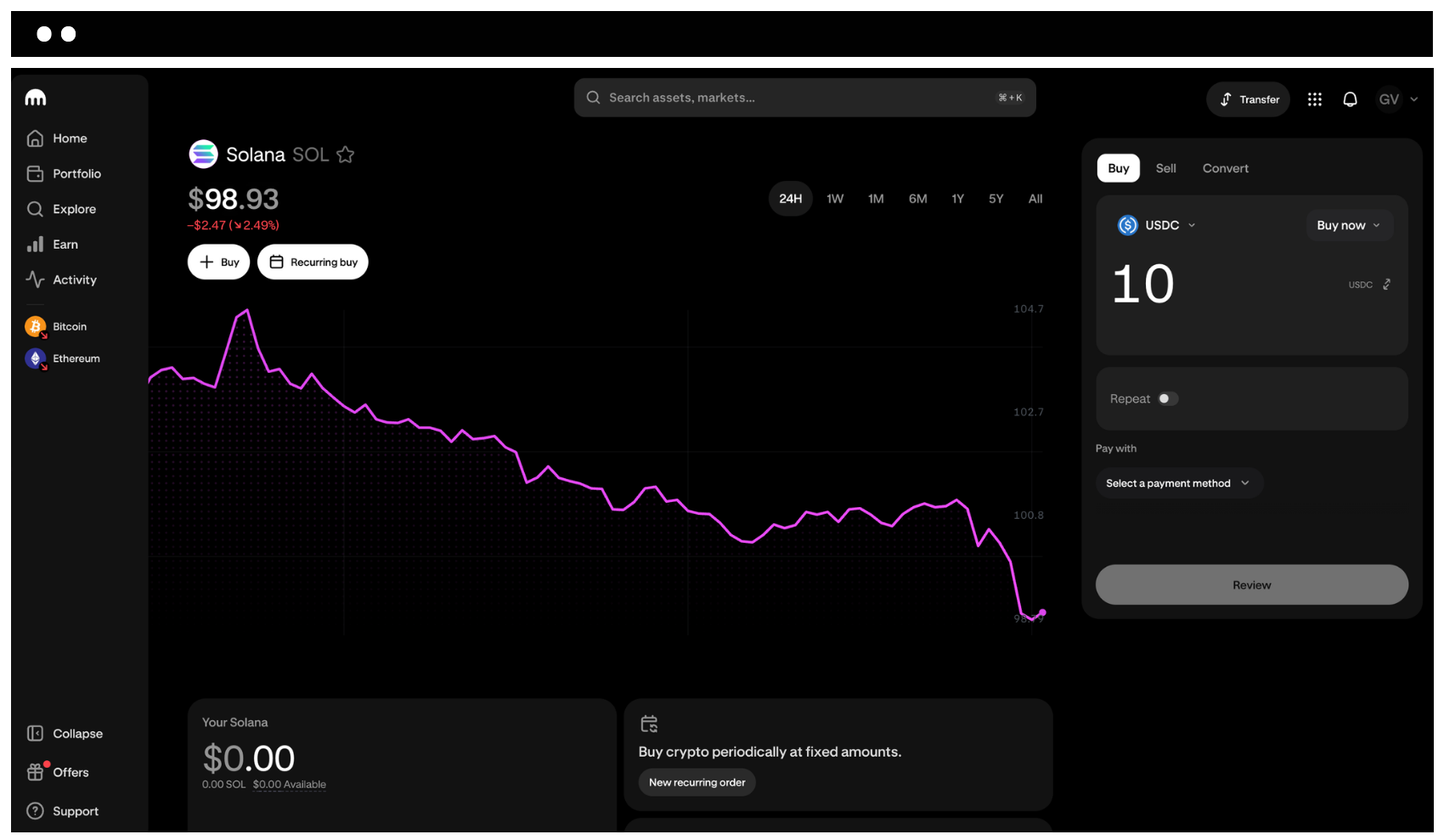
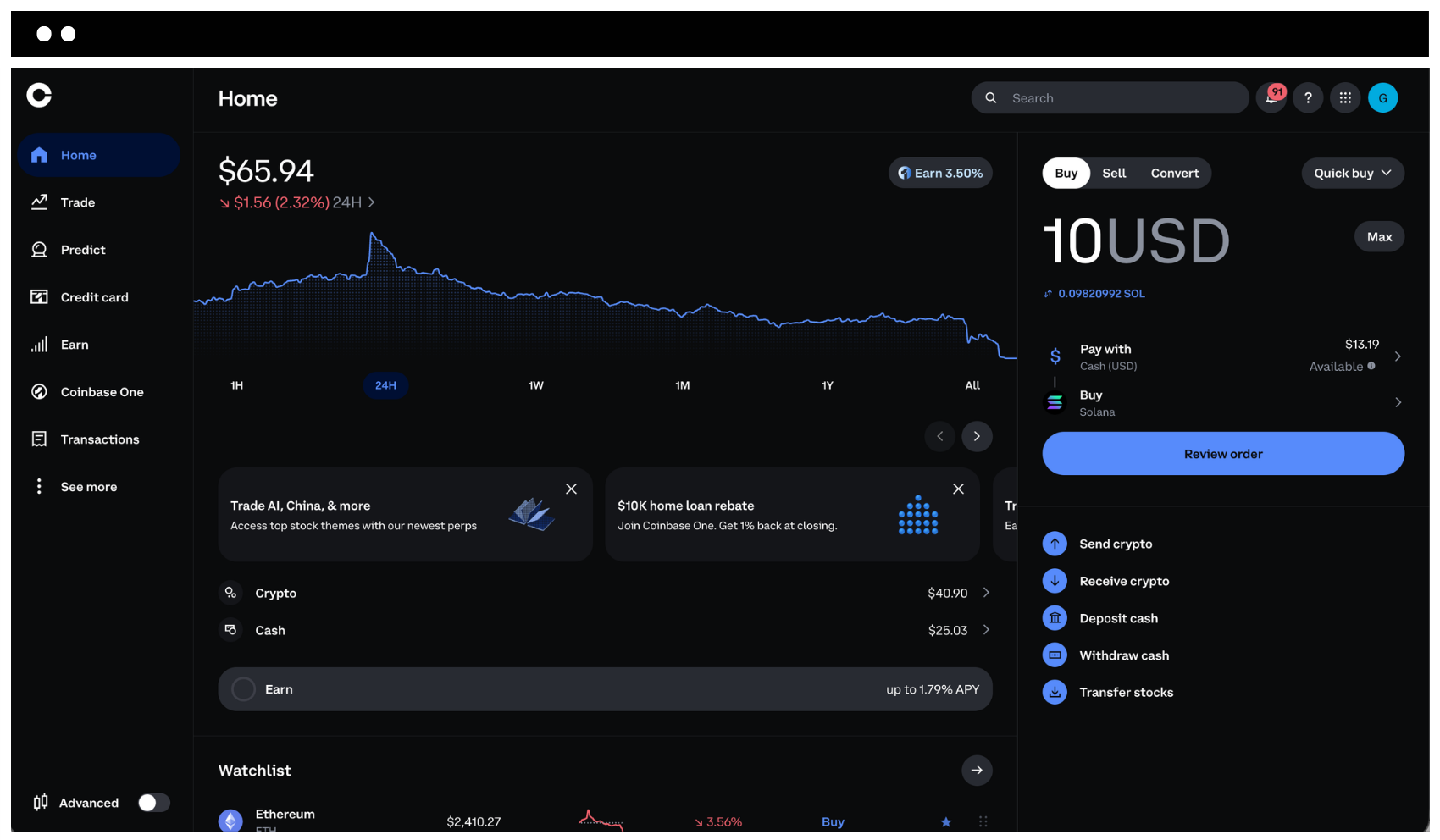
The whole point here is to give you a platform where you can on-ramp, swap, trade, transfer, and even off-ramp.
Fees Compared
The fee structure varies per exchange. It's also worth understanding slippage, since that can eat into a trade just as much as fees do.
Depending on the product that you use, for instance, Coinbase versus Coinbase Advanced, it changes your expenses.
Breaking down exactly the fees that either exchange has only matters for a certain time, which is primarily the reason why we don't wanna highlight it in this write-up.
If you really wanna join crypto, you must get used to being a scholar and consistently educate yourself on how your exchange of choice handles its fee structure.
Therefore, make sure to check the links for both Kraken and Coinbase.
They were lucky to have AI, and to leverage it, a cool way of doing it is to pair your favorite exchange with an MCP.
In simple terms, once you connect both sides of the equation-again, in this case, your favorite AI tool and your favorite exchange. You can optimize for anything that you like.
A cool hypothesis that's worth testing is connecting both exchanges to a single MCP and giving it a rule with a timeline, where assets are swapped and transferred to the centralized exchange that gives you the biggest yield. Or to the ones that save you the most risk at the expense.
Kraken Pro vs. Coinbase Advanced
Both platforms offer a two-tier pricing model.
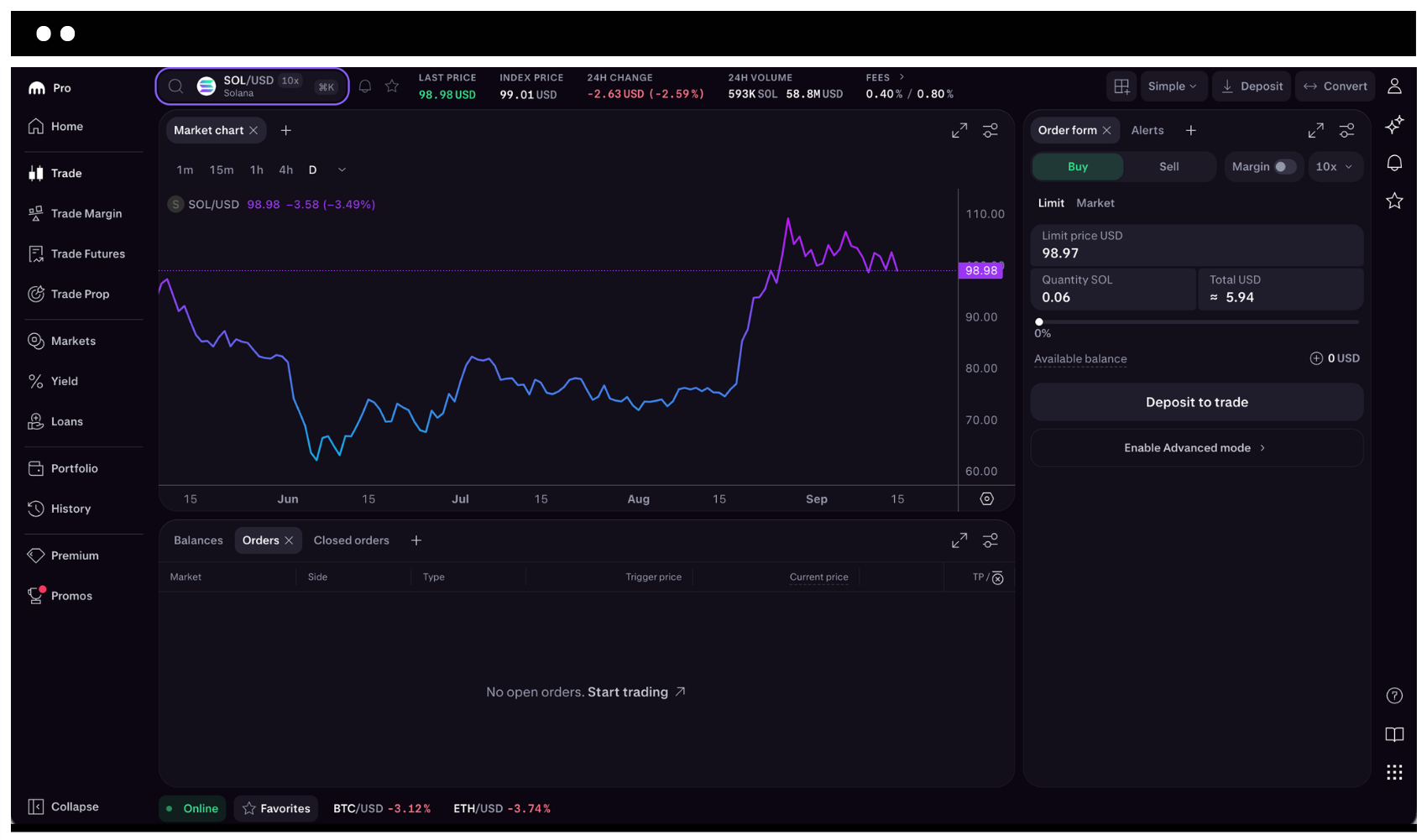
Very similar, to be honest.
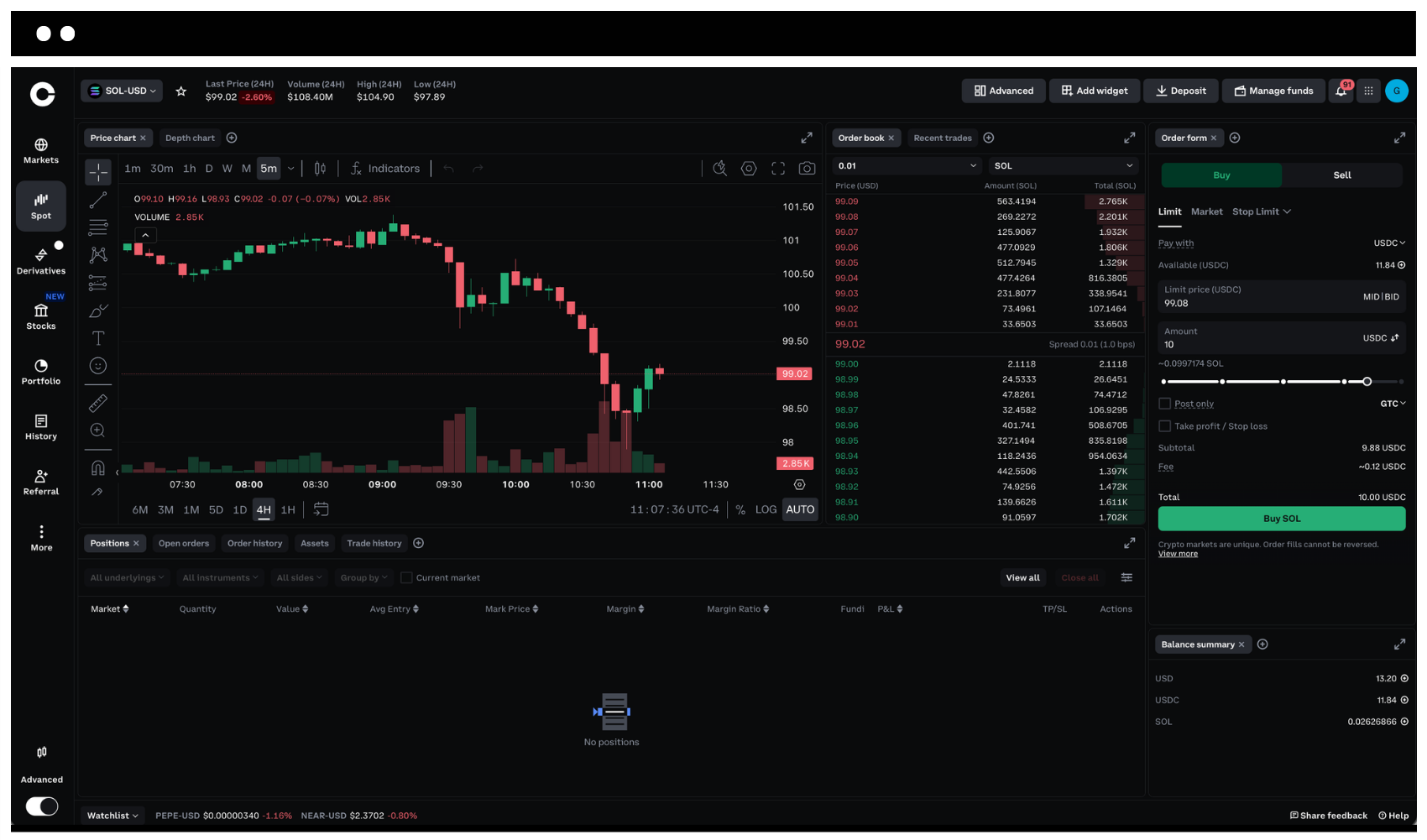
To get started, you really do not need Kraken Pro or Coinbase Advanced.
From personal experience, I learned a lesson when I bought over $10,000 worth of Ethereum and spent somewhere between $400 and $600 just on fees.
I could've listened to my friend Alex Choi. He's a top UX designer for dYdX/Arcus, and he literally told me that I could use Coinbase Advanced and trade with no fees.
Which happens to be true to this day.
If I were to start over again, I would first pay attention to their fee structure plus the assets that are available on the exchange.
Instant Simple Buy Fees
There's a double-edged sword to this.
Even though it's cool to purchase or sell quickly, it can also develop a habit of FOMO, meaning fear of missing out.
Trading is pretty funny in my opinion, unless you actually understand the underlying asset and team your financing.
On the other hand, if you buy an asset without understanding it, you might be what we like to call in crypto an Oompa Dumpa.
Just always think that there's another person that's taking the hit if you're selling. Picture it's your grandmother. That's my rule of thumb.
Don't do to others what you wouldn't do to your grandma.
In terms of fees, just go with what's best for you. Obviously, the cheaper, the better.
But the whole point of saying the above is for you to be responsible and help us grow an industry that has proved over and over that we have a better product than traditional finance.
Deposit & Withdrawal Fees
My preference is pretty straightforward.
If both exchanges were to offer the same, I would simply opt for the one that has the cheapest on-ramp fees.
On the other hand, if an exchange were to spike off-ramp fees, it could potentially mean that they want to support the ecosystem, which is great.
There's a scenario where the exchanges are facing a liquidity crunch, which means that could be the reason for spiking withdrawal fees.
Ease of Use & Features
I've used both platforms, to be honest, and at this point, it's safe to say that Coinbase has an advantage.
One of my favorite features from Coinbase is its credit card that was developed in partnership with AMEX.
Mobile App & First-Buy Experience
It really depends on what you like.
I've tested both exchanges, and they're both pretty good.
If this is your first time trying out an exchange, I'll give you two options: put $5 on each.
On the other hand, if you have somebody who has tested either platform and can teach you, learn from them while not letting them influence you to put more than $10.
If you're flying solo, just check out which app has the best reviews. Remember that wasted time translates into sunk cost, and since you're only putting in a very, very small amount to test them out, you might as well try your favorite pick today.
Advanced Trading Tools
When it comes to Coinbase they offer something called Coinbase Advanced.
On the other hand you have Kraken, offering you the standard Kraken app, and for advanced trading tools, you have the Kraken Pro.
Be mindful that Kraken for instance serves a number of apps beyond just Kraken Pro. These apps are useful for things like basic trading which relates to the classic Kraken app.
Don't get them confused with the Krak money app, similar to Venmo. Or Kraken Wallet, which is a multi-chain self-custody wallet.
The dope part of both of these is that you can now trade tokenized stocks like traditional exchanges have been doing so for a while.
If you're just getting started, it's not a bad idea to test them out right away.
The edge here in my opinion is that these advanced trading tools may offer you cheaper fees either right away or after paying a small monthly fee.
Supported Cryptocurrencies
As of today, Coinbase supports over 18,000+ assets. Check their official live count.
Whereas Kraken offers over 300 assets.
The most amazing part that recently happened was the tokenization of traditional assets.
We went from just trading digital assets to also including traditional assets in one exchange.
The best part is that even if you were to just on-ramp cash, you still have to consider it as another asset for the exchange.
As they pull in cash, also known as fiat, they'll be able to leverage better financing, which translates into better APYs in the form of staking.
For those who want to join crypto, I highly recommend that you spend no more than $10 and stake it immediately.
Luckily, if you're willing to take the risk, they offer better APY rates than most banks today.
Security & Regulation
When it comes to security, it's best to rely on top auditing watchdogs like CertiK and Arkham.
In terms of both security and regulation, my north star is Coinbase.
Brian Armstrong is by far the strongest entrepreneur when it comes to pushing compliance and regulations to have a better playing field for the industry.
He's perhaps my favorite founder when it comes to exchanges. Credit where credit is due.
When it comes to security, I would opt for the exchange that has the best two-factor authentication, which means that there are more barriers to accessing your account.
Coinbase: Nasdaq-Listed, FDIC-Insured Cash Balances
This is another edge for Coinbase.
The fact that the company is listed publicly means that it's getting audited heavily, which means consumers have more protections.
Because it's a tech company and one of the best in the world, it's been accepted onto NASDAQ, which is a very, very strong stock exchange index for tech companies.
On top of that, your cash balances are protected just like a bank in the United States, with FDIC insurance, meaning that your assets are protected as long as they are not above $250k in fiat.
Remember that step one to use an exchange is to on-ramp fiat, better known as cash, into crypto.
Without it, you can't really do anything on a centralized exchange, nor participate in crypto in any way.
Picture it: the moment that you deposit cash into the exchange, you automatically get yield.
It's happening everywhere and not only on Coinbase and Kraken, but also in prediction markets like Polymarket and Kalshi.
I invite you to join crypto, because we are the future of finance.
Give it a shot. It takes just a few seconds after you download the app.
Kraken: Proof-of-Reserves and Security Track Record
On the other hand, we have Kraken. Like many other exchanges competing for the top, these folks also have to prove they actually hold their assets.
In crypto, it's actually pretty easy to do so if you grade their ledger. Once you find the wallets that are tied to any exchange, you can figure out if they actually hold the assets or not.
Beginner or Active Trader?
One of the cool things about these companies is that they spend a lot of effort trying to educate the user.
Yet, there's a downside to all of this.
During the early days, exchanges only listed a few assets.
But now we see all sorts of memecoins and speculative assets.
No issue with the above, but there are better entry points for people to get started.
My philosophy here at Joined Crypto is that each opportunity needs to be grandma-ready.
Again, $10 is all you need to join crypto.
For everybody that's getting started, the play is to on-ramp fiat to crypto and leverage staking, which is basically an APY.
Is It Available Where You Live?
This is a question you have to ask yourself.
At JoinedCrypto, we have readers from all over the United States.
If you read any of our previous pieces, you'll understand that we heavily emphasize that you study your local jurisdictions.
To do so is simple: just think of where you live, and refer to the terms and conditions of the exchange afterward.
Refer to both Coinbase's and Kraken's terms and conditions to make a choice.
Staking & Earning Rewards Compared
This is the juicy part of the write-up.
The best way to grow this industry is to on-ramp a humble amount of fiat.
It really doesn't matter how much you put in. Stablecoins are a popular asset to stake if you want yield without the price swings.
I again recommend you start with $10. And then stake it, which means gaining yield at an APY.
The most badass part is that the industry has come far enough that you do not have to stake your assets for too long. You can actually stake things for a day or for a millisecond. It really doesn't matter to us.
This is my favorite choice to onboard people who wanna join crypto.
It's by far the most grandma-ready strategy for people to have fun in space while being risk-averse.
What Traders Actually Say
There are two types of reviews.
Qualitative versus quantitative.
As a North Star, we're gonna focus on Apple's iOS and Google Android's Play Store reviews.
The metrics you have to pay attention to are the number of times the app has been downloaded and the stars it has, which are quantitative.
And lastly, the actual reviews that have been written by users, which are qualitative.
If this is your first rodeo, I would start with these metrics.
Aside from that, ask your friends and family.
Common Questions
Which is cheaper, Coinbase or Kraken?
Kraken is cheaper.
Taker fees represent limit orders that stand as a contract saying that you're either buying at a particular price.
On the other hand, you have taker fees. Which are basically pulling out liquidity from the exchange.
Kraken Pro starts at 0.25% maker and 0.40% taker, while Coinbase Advanced Trade starts around 0.40% maker and 0.60% taker.
Is Kraken safer than Coinbase?
They are both cool.
Coinbase is FDIC insured, which means that all your deposits are protected.
On the other hand, you have Kraken, which has a clean record with no hacks.
Can I use both Coinbase and Kraken?
Yes.
Can I use Kraken like Robinhood?
Yes.
Is Kraken or Coinbase better for beginners?
It really depends; it's all about who has the best education for beginners.
Test both, the more the merrier.
Follow both CEOs, because they set the tone and how the company operates.
You can find them both on crypto X, formerly known as crypto Twitter.
How much does Coinbase charge for a $1,000 trade?
If you want to bypass the fees, all you have to do is switch a toggle to trade on Coinbase Advanced. Which offers lower fees.
Can I cash out $100,000 from Coinbase?
The answer is yes. You can cash out even more.
The one thing you have to be careful with is not triggering a security alert that will delay that process.
One thing that I learned is that if you are based in the United States, and travel abroad your IP will likely trigger a security feature.
Pay attention to the above if you're moving significant volume.
Which crypto platform is best in the USA?
I can't really tell you because they offer more or less the same things.
Yet again in terms of traffic Coinbase is the people's choice.
Is Kraken better than Coinbase?
There are two lanes you should analyze.
One is compliance, and in this case Coinbase rules.
On the other hand, Kraken offers a top of the line trading product with cheaper fees and some aspects.
Both are amazing, start with $10, and put half on each.
What's the difference between Kraken and Kraken Pro?
The difference is in the features they provide.
If you're a beginner, Kraken is just fine, and then test Kraken Pro.
How does Gemini compare to Coinbase and Kraken?
Gemini is a legit competitor worth testing out.
Yet in terms of traffic volume, people are opting to work with Coinbase and then Kraken.
I believe in the Gemini team. As long as they benchmark their competition, they will catch up.
What are Kraken's withdrawal fees?
You can refer to Kraken's fees on their official website.
There's no point in signaling an exact metric because they often change.
If you're going to put money in an exchange, make sure to also keep an eye on the fees page and also the announcements of the CEO.
I'm personally not a fan of withdrawing, since fiat off-ramps don't help crypto in any way.
The future is on chain. A better product than what traditional finance has to offer.
Is Kraken good for day trading?
I'm personally not a big fan of day trading. Yet again, both platforms work just fine for it.
Invest in what you believe in long-term, work with that 10-year plus horizon.
Are there alternatives to Coinbase and Kraken?
There are so many exchanges that I've lost count.
Since we tailor to the US audience, make sure you're not breaking any local jurisdictions and you'll be protected by the law.
Bottom Line: Which Should You Choose?
This is really up to you.
I've tested both, and as of late I'm more on the Coinbase side of things.
Kraken is still pretty fire though.
It depends on what you're looking for and your priorities.
For instance, if you are looking to save money and test yourself out with something like $10, then you might be prioritizing fees. The more money that you save, the more money you can invest.
Not all exchanges list all assets.
In that case, you might have to prioritize based on the listings that they have on hand. Just understand that you need to figure out how much they actually hold. Without liquidity, you face challenges in terms of buying and selling, which translate into more cost for you.
If you're interested in the above, we've written pieces about how market makers work and how they provide liquidity. If the exchange order books are running slim, it means the exchange needs to pull liquidity to protect its users.
As a rule of thumb in finance, if you see any company providing yield above market rate, it's because they need it.
Luckily, both Coinbase and Kraken are led by top entrepreneurs who like to compete. Growing a crypto exchange business is no small task, which is part of why both platforms keep competing on fees and features.
Neither of them offers the most yield in the market for a reason.
And the answer is simple: it's because they simply don't need it.
If you understand the above, you will figure out one of the biggest secrets in banking and in finance.
Take the challenge if you want to join crypto.
Many have already Joined Crypto.
Your turn.
Disclaimer: Some links in this post are affiliate links. When you click through and make a trade or sign up, we may earn a small commission at no extra cost to you. We only recommend platforms and tools we actually use and believe will help you navigate the crypto markets more effectively. This helps us pay the bills and keep delivering the alpha and market insights you rely on. Thanks for supporting Joined Crypto!





.png)