I’ll start with this.
“Stablecoins are the best cryptocurrency to onboard newcomers, along with Bitcoin.”
There, I said it.
The reason is that lots of newcomers start their crypto journey with the hopes of scoring big, chasing green candles day and night.
Sadly, many get “rekt” (wrecked) chasing those candles, with their portfolio hitting rock bottom, leaving crypto entirely.
Yet, crypto offers much more than trading, especially from a social and collecting aspect.
“Imagine telling Granny to put her hard-earned $100 on crypto, just to turn around, and a 20% chunk is gone in a day or two.“
It simply does not sit right with me.
Instead, stablecoins work just fine to purchase a piece of art from an upcoming artist, buy in-and-out on a funny memecoin, tip a creator, stake for yield, and more.
I’d love for folks to start their crypto journey this way, in a more hands-off environment, where their portfolio won't vanish overnight.
With that being said, I once again reiterate that stablecoins will be key to mass adoption.
No one thinks of fiat as they use it. They simply use it, period. That's the goal that stablecoins, in fact, the entire cryptocurrency market, should aim for. To deliver a seamless experience.
Behind the scenes, the stablecoin crypto asset class is growing at a relentless pace.
Ever since stablecoin launches, the market cap has looked up and to the right.

The best part of all is that you are early. Like, very early to all this.
As of January 2026, the term “best stablecoin” has less than 400 people searching for it on a monthly basis in the United States.
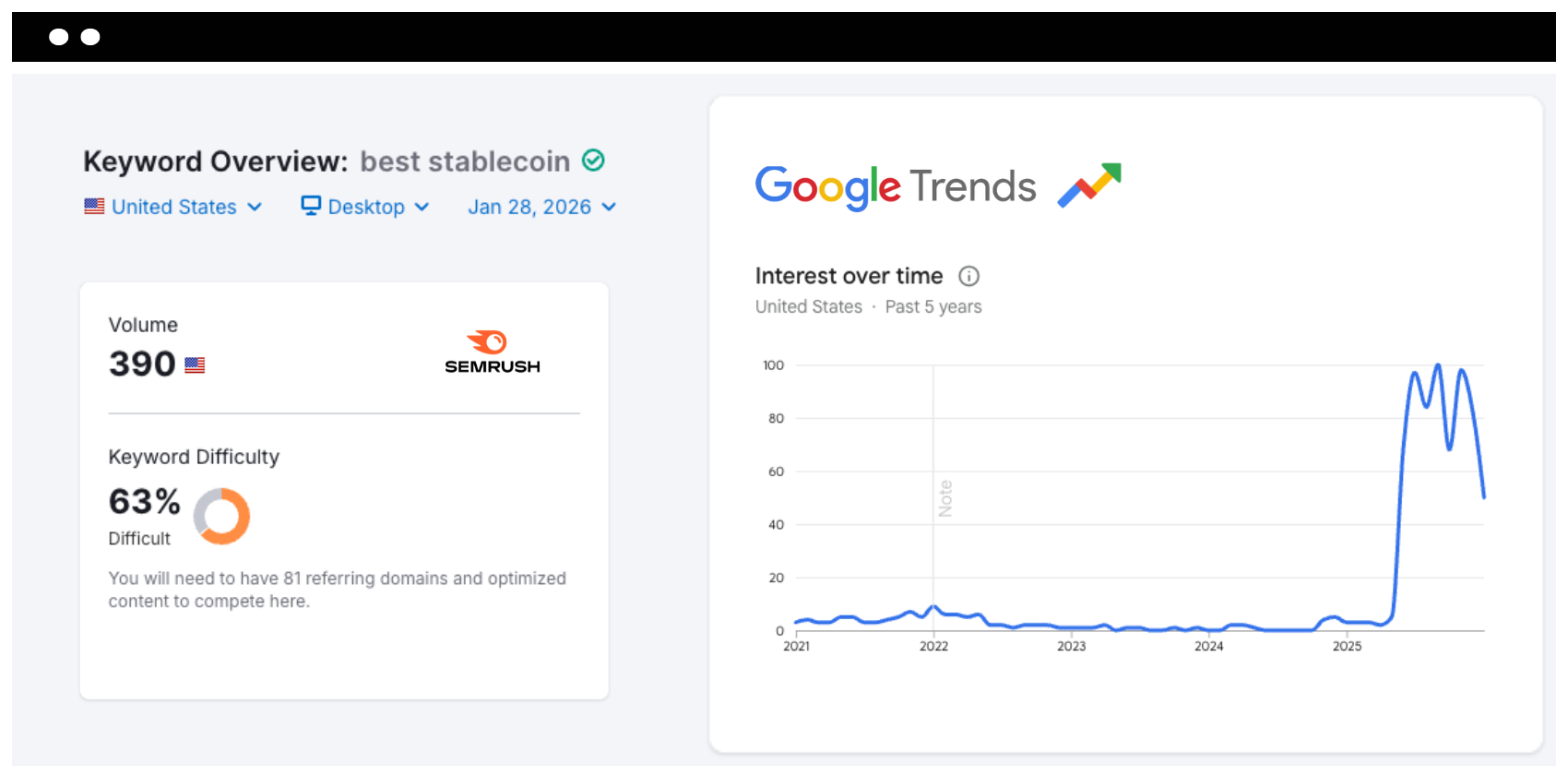
That early.
What is a stablecoin?
A stablecoin is a cryptocurrency designed to maintain the value of a particular fiat currency, say the Dollar or the Euro.
The coins are pegged 1:1 with the currency of choice.
Dollar and Euro-backed stablecoins already exist. Essentially, every world currency can create one.
So, for example, $1 of USDC is theoretically the same as $1 in fiat currency.
Fiat is the cash we use today for daily transactions.
At a micro scale, even companies can create their own stablecoins, as long as they have the supply to back it. That’s why you see companies spawning their own stablecoins left and right.
You get the global utility, near instant settlement, and transparency that fiat money cannot offer, while also skipping all the gut-wrenching volatility of other cryptocurrencies.
How are stablecoins backed?
They are all created slightly differently. The fiat backing infrastructure is what matters most today.
Let’s break down the main types:
Fiat-backed stablecoins
The most straightforward of all types. It relies on the stablecoin to be fully backed 1:1 to the currency of choice, as explained earlier.
To simplify further, if you hold $100 of USDC, then Circle, the USDC holding company, holds the equivalent $100 in U.S. dollars in its account.
The issue is that they rely on audits to showcase that they hold what they claim, a process that will remain as long as the assets are off-chain.
Audits require time and resources, and are typically done monthly. They are not instantly verifiable like crypto assets.
Crypto-backed stablecoins
Perhaps the most crypto native of all options.
Instead of backing the stablecoin with a fiat currency, the crypto-collateralized stablecoin is, as the name says, pegged to another cryptocurrency.
So yeah, reserve assets here are a bit different.
No U.S. T-bills, or 1:1 fiat, they use crypto collateral to maintain a stable value.
They are instead likely tied to a large-cap, such as Ethereum, that suffers less volatility.
In my opinion, these are not to be frowned upon. They deliver counterparty risk by avoiding all your portfolio being backed by "digital fiat currencies".
In the future, I think using crypto-backed stablecoins alongside fiat-backed ones will be the norm.
Even though I might be alone on this, I'd love to call these "decentralized stablecoins" instead. They embody the true cyberpunk philosophy of moving everything on-chain.
Commodity-backed stablecoins
Some stablecoins are building collateral with other asset classes, like commodities.
Assets include oil, gold, silver, and other precious metals.
I do find it harder to track in a portfolio. You have to bet on the market capitalization growth of all these assets to ensure the stablecoin's prosperity.
These are obviously subject to market stress and could potentially harm the stablecoin peg.
Algorithmic stablecoins
No collateral backing it, just code that automates supply and demand orders to maintain the peg.
What seems cool in theory has backfired tremendously with this model, with de-pegs happening due to bugs or hacks.
Not a big fan of this model, to be honest.
Warning note: The Luna Story
Learning about the story of Luna's algorithmic stablecoin catastrophe will make you realize that these don't really work like government-backed currencies, but like businesses that can make costly mistakes.
Smart contracts might have bugs, vaults can get hacked, collateral can evaporate, etc. The operational risks are there. Things that seem unphathomable for the biggest players in traditional finance.
All stablecoins can suffer the same consequences, but algorithmic mechanisms have taken the greatest hit.
These are issues you will likely avoid if you stick to the biggest players, USA₮ and USDC.
Hybrid models
The name is self-explanatory. These typically rely on a combination of fiat, crypto, and real-world assets (RWAs) to maintain their peg.
It could be backed by physical assets too, like a building or land.
It could be a combination of all the models mentioned above. Anything really.
More often than not, these rely on overly complex mechanisms.
Do the research, and try these at your own risk.
Where can I use stablecoins today?
When it comes to making crypto-to-crypto transactions, stablecoins are pretty much an option everywhere.
When it comes to buying everyday things like bread or paying rent, things are progressing quite nicely as well.
Even though stablecoins are still on the come-up, the chances of you using them for everyday things are increasingly rapidly.
In fact, many vendors already accept crypto, and stablecoins are no different.
The best crypto banks, in collaboration with exchanges, are offering credit cards that let you spend stablecoins at checkout. Where your stablecoin swaps into fiat at the point of sale.
Visa, Mastercard, and American Express have all ventured into building cards funded by crypto.
Let's explore some of the best use cases in the market today.
Payment and remittances
Functioning like fiat, but with cross-border transaction capabilities, and especially used in countries with inflationary economies.
Forget about bank holidays, expensive wire fees, and long waits.
Stablecoins represent a huge opportunity.
Tipping and micro-payments
Tipping online has become more of a thing lately.
For those living off streaming or with a nomadic lifestyle, stablecoins offer several advantages.
When it comes to video streaming or podcasting, stablecoins allow those with a global fan base to gain from their cross-border capabilities and lower fees.
If you are traveling the world and working in the restaurant industry, for example, you could receive stable payments regardless of the currency situation where you stay. Travel and work away, knowing that your hard-earned money is not being devalued.
Exchange Trading Pairs
Stablecoins are commonly used as pairs to trade other tokens, with both centralized and decentralized exchanges offering such features.
In today’s crypto market, almost all major exchanges offer stablecoin support.
DeFi
From lending to borrowing, to getting yield, and playing with perps. Stablecoins operate with the same DeFi qualities as other main cryptocurrencies like Ethereum or Solana.
The stability they provide makes them the backbone of most decentralized finance.
Memecoins
Kind of counterintuitive but still worth mentioning. If you are a fan of stability but also have a knack for risk, knowing you can use stablecoins to trade memecoins might go a long way.
The best platforms to trade memecoins, such as Axiom or Photon, give you the chance to trade with leading stablecoins.
NFTs and Digital Goods
Just like any other asset, stablecoins can be used today to purchase NFTs and other digital goods.
Let’s be real, seeing the price of the asset in stablecoin is also much more straightforward than seeing it priced in on Ethereum or Solana.
Payroll and payment management
Global businesses operating with payroll or payment tools can easily benefit from stablecoins.
If they can work with fiat currency online, working with stablecoin tokens won't be much different.
With stablecoins, the company can complete cross-border payments, bypassing expensive wires and timely settlements with high precision.
It also gives employees around the world financial stability, especially for those living in countries with volatile currencies and financial stability issues.
Imagine telling an employee in a 3rd world country that they will be paid in stablecoins, matching the U.S. dollar. And it cannot be compromised by some weird egalitarian regime.
They will finally be able to leverage a proper currency that maintains price stability and reserve transparency.
Stablecoin Adoption Today
According to Visa’s Stablecoin Analytics, there were over 361m total active unique addresses during the past 12 months, and climbing.

It also demonstrates how distant stablecoins are from traditional payment champions like Visa, which processed over 257 billion transactions in 2025. In contrast, all stablecoins combined only managed to generate 12.9 billion.
When fiat gets turned into stablecoins its called “minting”. And in relation to the supply, we can see a steady trend upwards, meaning that there are more stablecoins in the market.
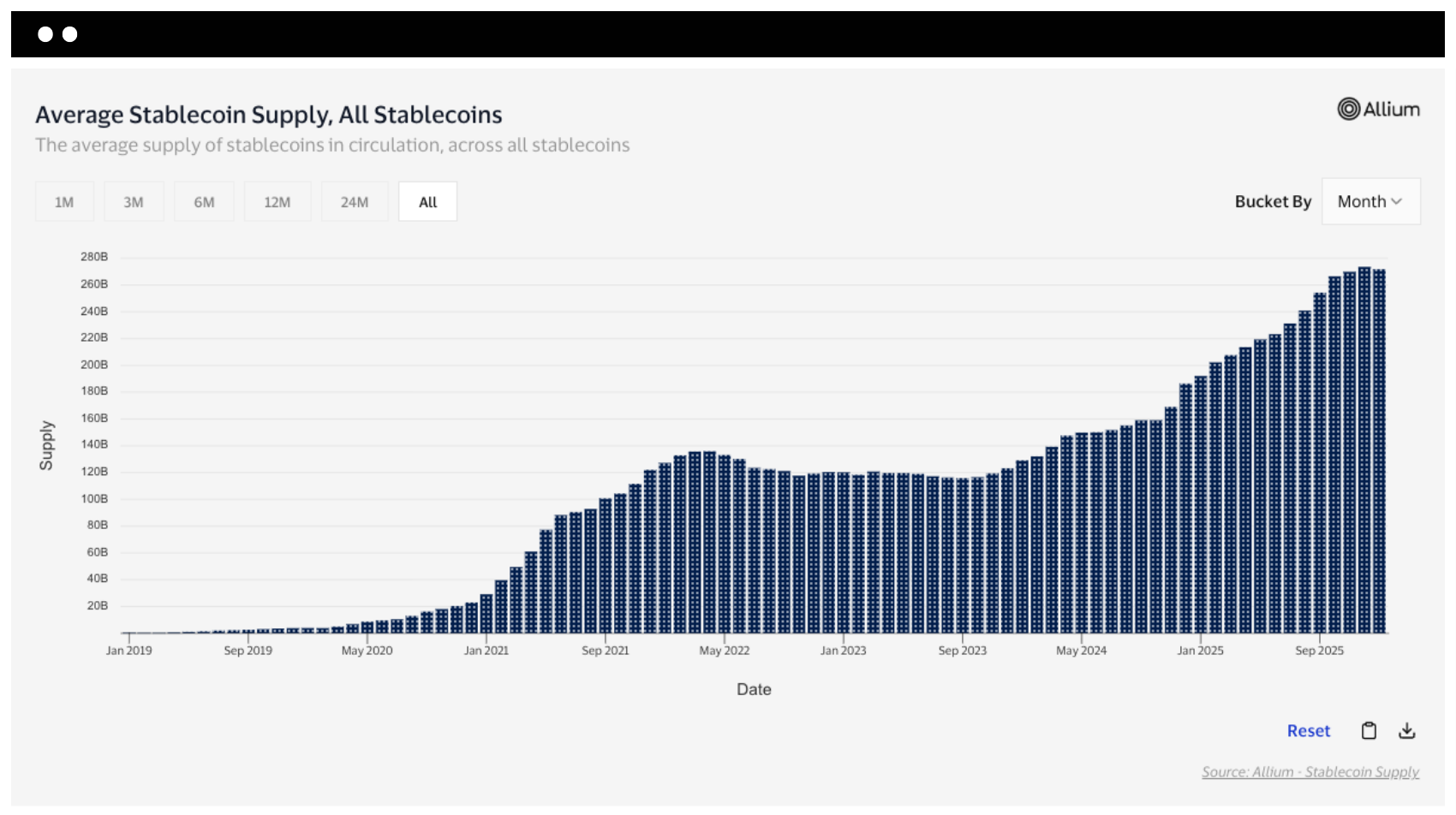
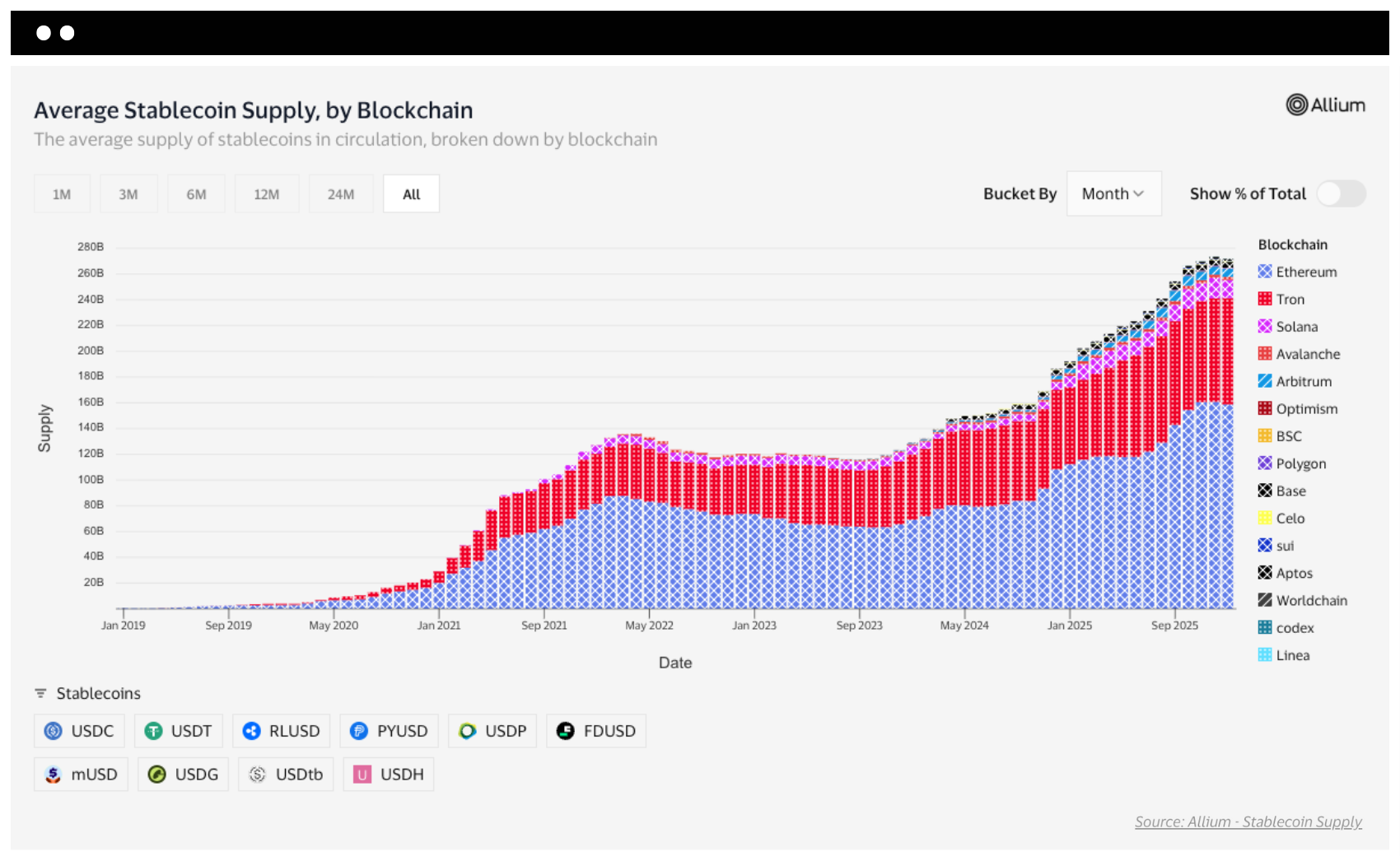
Historically, USDT and Circle have dominated the market when it comes to stablecoin supply, and continue to do so.

The chains where these stablecoin giants operate are mainly Ethereum and Tron, with Solana also entering the scene.
And it’s also where most volume runs.
Remember, in simple terms, stablecoin supply is backed by its 1:1 fiat equivalent. The more supply there is, the more there is to transact with.
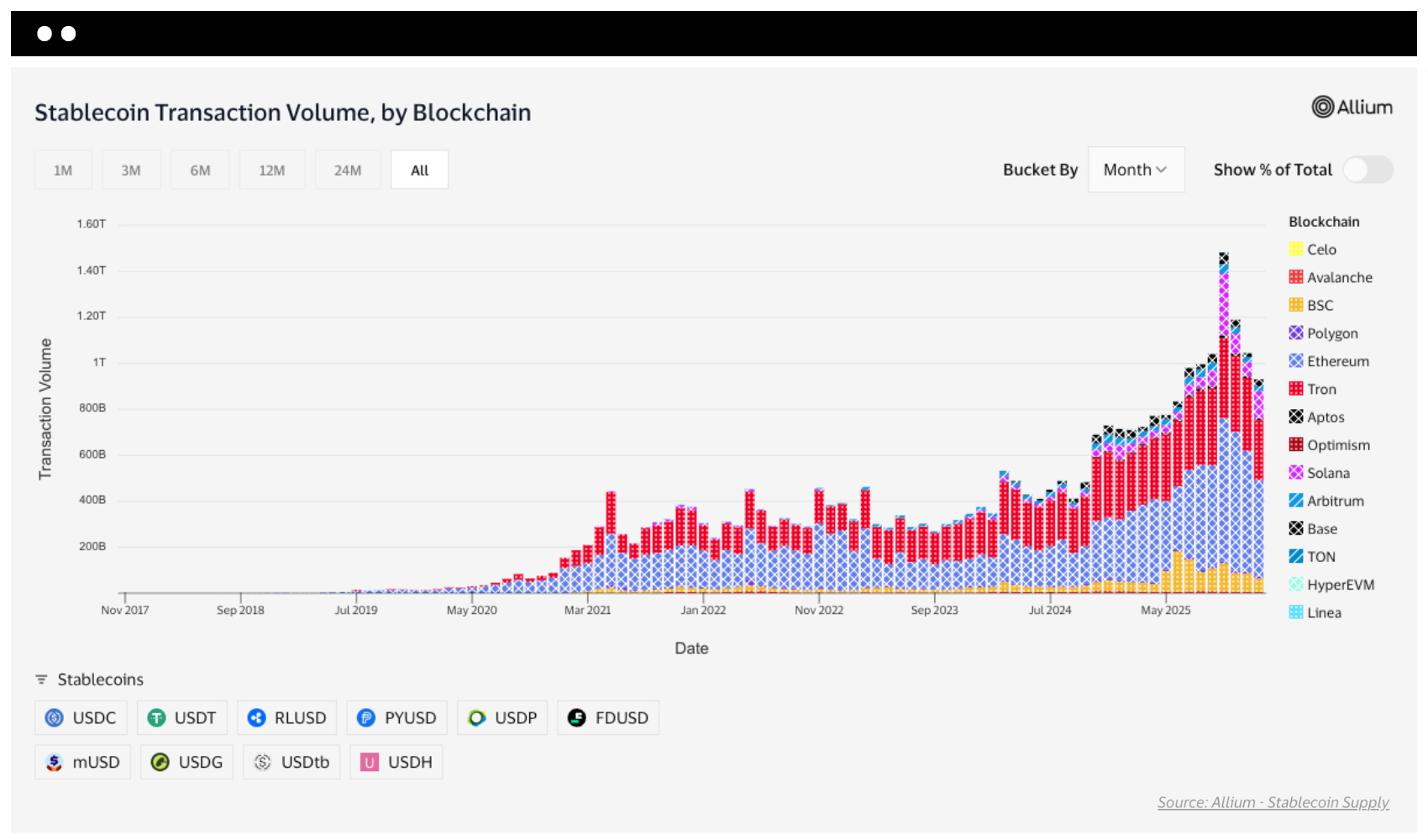
The most active chains for stablecoin transactions include Binance Smart Chain (BNB), Tron, and Ethereum.
Meaning that tons of transactions are flowing on these chains. They are competing to process high transactions per second (TPS), a core metric for all fintech providers.
5 Best Stablecoins in 2026
If you are going to be working with stablecoins long-term, you might as well stick to working with those that already provide the most supply and transact the most. Tether (USDT) and Circle (USDC) are the main players.
These are all companies that have passed the strict regulatory compliance hurdles, some that have halted the industry for years.
We will look into fiat-backed stablecoins, crypto-backed, commodity-backed, algorithmic, and hybrid model stablecoins. We will also see their distinctions based on their collateral and working capital.
"These are all the best stablecoin issuers leading widespread adoption."
We go over:
Also, give their accounts and founders a follow on Crypto X to stay up to date with the latest updates.
Tether (USDT / USA₮)

Type: Fiat-Collaterized
X: @Tether_to
CEO: Paolo Ardonio (@paoloardoino)
Tether broke ground as the flagship stablecoin in crypto back in 2014.
The first digital USD coin to exist, creating a new digital asset class of its own, the stablecoin.
It’s by far the most traded cryptocurrency, and it supports around 70% market share of the entire stablecoin market, with over 500 million users, and counting.

USDT is backed by fiat-collateralized, meaning that it is backed by liquid assets. These include U.S. dollar deposits, treasury bills, and cash equivalents.
A true 1:1 peg.
In 2025, they became the largest buyers of U.S. Treasuries globally and expanded into investments in Gold, AI, Bitcoin mining, and energy.
The OG, rogue player, of all sorts, has taken over the market by storm. Beating every compliance hurdle along the way.
One of the important things to note about Tether is that it just became fully U.S. regulated and consequently launched its U.S. specific stablecoin, the USA₮.
The release was done in January 2026.
So it’s fairly recent.
It was exactly what was missing to really counter its competition and tap into the U.S. market.
Even though competitors are catching up, they are still far from Tether’s rearview mirror.
Circle (USDC)
Type: Fiat-Collaterized
X: @circle
CEO: Jeremy Allaire (@jerallaire)
For those looking for the most strictly regulated stablecoin in the market, Circle’s USDC delivers.
It was launched in 2018 through a partnership with Coinbase, a perfect partner to address the U.S. market.
It runs monthly audits from independent auditing firms, with reserves held in U.S. Treasuries and cash.
In June 2025, Circle became the first stablecoin company to go public on the New York Stock Exchange (NYSE).
It has also been well integrated with players like Visa and BlackRock.
A world-class stablecoin option that goes head-to-head with Tether’s USDT, and it is highly respected and used by top institutions today.
Sky (DAI)
Type: Crypto-Collaterized
CEO: Rune Christensen (@RuneKek)
Founded in 2017 by Sky, formerly known as MakerDAO, it’s the only crypto native stablecoin on the list.
Meaning that this stablecoin is fully crypto-collateralized, and it maintains the dollar peg without holding any.
Instead, it's all backed by other cryptocurrencies with assets like Ethereum locked in smart contracts for the long term.
All assets are instantly verifiable in their vaults, thanks to the transparency of blockchain technology.
The goal was to create a stablecoin that did not rely on trust to prove that the collateral actually exists.
And crypto certainly solves that.
DAI avoids banks or centralized issuers from taking over the stablecoin market.
Paypal USD (PYUSD)

Type: Fiat-Collaterized
X: @PayPal
CEO: Alex Chriss (@acce)
PayPal is the founding company of PYUSD and stands as the first major U.S. fintech institution to jump into the stablecoin scene.
Its launch in 2023 quickly connected millions of users to stablecoin access, all via their already popular desktop and mobile apps.
It’s issued by Paxos Trust Company, under NYDFS oversight, and backed by dollar deposits and short-term Treasuries, redeemable 1:1.
Similar to its competitors.
You can spend it anywhere PayPal is accepted, which is practically everywhere.
Ripple (RLUSD)

Type: Fiat-Collaterized
X: @Ripple
CEO: Brad Garlinghouse (@bgarlinghouse)
The newest on the list.
Ripple’s RLUSD has gained immense attention after its December 2024 launch.
Each token is backed 1:1 by dollar deposits, U.S. government bonds, and cash equivalents. With audits handled monthly.
Despite Tether taking the mammoth market share of the market, note that RLUSD stands as the third biggest U.S. regulated stablecoin behind USDC and PYUSD.
When browsing SEMrush, an SEO tool that shows keyword search volume, I was shocked that RLUSD is in fact one of the most searched stablecoins out there.
How to buy Stablecoins
The following companies all offer ways to purchase and trade with the most popular stablecoins.
Centralized Exchanges (CEXs)
These allow you to swap fiat into crypto, and custody it in a centralized manner.


Decentralized Exchanges (DEXs)
Decentralized exchanges only operate with crypto. Making buy and sell orders will have to be done without fiat, no exceptions


Aggregators via Wallets
Crypto wallets often offer swapping capabilities, via something called aggregators or by calling other DEXs. This allows you to buy stablecoins right from your wallet.
If you need more wallets to try out, our recent best NFT wallet post can help.


Yields with Stablecoins
Today, we have specific yield-bearing protocols ready to give you yields that could go higher than 10% APY for your stablecoin.
Interest yield numbers that traditional banks can’t fathom.
These are services that centralized exchanges (CEXs), decentralized exchanges (DEXs), and even wallets are starting to offer as well.
Revise the list of CEXs, DEXs, and aggregators via wallet to start comparing earning yield rates. It’s common to see them offering these services as “staking”, which are the yield-bearing services we are talking about.
In a matter of a couple of clicks, you could be earning yield on your stablecoins.
It’s quite simple, really.
Just know that when it comes to staking, you might have to lock up your supply for a particular amount of time. It depends on the platform.
For example, you could lock up $10,000 at an 7% APY for one day, weeks, months, or more.
To make it even easier to calculate the earnings of your yield, check out our stablecoin yield calculator below.
If the yield looks good to you, check out Aave’s product below.
Aave
If you hold some cash or crypto, know that Aave claims that it can give you up to 9% (APY) yield.
They are the leading lending and borrowing protocol with very competitive yields.
Their app allows you to deposit for yield directly from your bank, via wire transfer, or crypto wallet.
Worth trying out, the app has a stellar reputation and a long tenure in the crypto space.
The Future of Stablecoins
The idea of leveraging stablecoins to gain yield has Congress in a tough spot.
Crypto companies are offering lucrative interest yields, beyond what a trad-fi bank could compete with. Therefore, coming to a middle ground has become a challenge.
The Clarity Act is at the center of all this.
If it were to pass, it would provide transparency for crypto companies to offer yield services. Specified in Section 404, titled "Preserving rewards for stablecoin holders".
And consequently, for banks to adapt.
These are bigger issues that take time. Perhaps because the money system has not been overhauled in a while, or simply because tinkering with the money system has an impact on practically everyone.
Conclusion
For me, seeing Circle in the NYSE gives me a lot of confidence in USDC, despite being second in supply and volume to Tether.
Now that Tether's new USA₮ stablecoin has been fully regulated in the U.S. as well, my opinion might change.
"The reason why Tether’s USDT was ranked above Circle’s USDC was that it holds more supply and has higher metrics, like volume and unique users."
So, which one is the best stablecoin?
It’s too hard to say, but without a doubt, it’s one between Tether's USA₮ / USDT and Circle's USDC, the ones with the deepest liquidity.
The reality is that not all stablecoins are created equal, and not all will be pegged to USD reserves.
New stablecoins are popping left and right, so doing your research can save you from catastrophe. Reading stablecoin regulation news is key to keeping up.
About 5 to 10 stablecoins have been issued in the United States so far, and many more are on the way.
Traditional money is not going away. There are simply new players in town and ready to compete.
As always, doing your research will pay off.
That's a wrap!
Stablecoins matter, dive into the research, and give it a try.
Time to explore stablecoin technology, a product that truly resembles what the future of finance is meant to be.
Disclaimer: Some links in this post are affiliate links. When you click through and make a trade or sign up, we may earn a small commission at no extra cost to you. We only recommend platforms and tools we actually use and believe will help you navigate the crypto markets more effectively. This helps us pay the bills, and keep delivering the alpha and market insights you rely on. Thanks for supporting Joined Crypto!









.png)