The forecast for the agentic economy keeps growing and scaling at a rapid pace.
That’s why ERC-8004 is important, and it’s a core ingredient of the trustless agent ecosystem.
For those who don’t know, ERC stands for Ethereum Request for Comment.
And in this write up you will also read about EIP, which means Ethereum Improvement Proposal.
Soon enough, we’re gonna have more agents than human transactions globally, and also in space.
AI agents are transacting over centralized servers, whereas those that join crypto work in a decentralized manner.
The whole point of ERC-8004 is to have a reputation score, where the AI agent can carry it so it can get hired by humans and also other AI agents.
In simple terms, ERC-8004 serves like a credit score for humans. If the agent does a good job, then obviously the score will be higher.
This is not only to catch bad actors on an agentic side, it’s also to catch the humans behind it.
This is one of the most interesting topics not only in crypto but in AI as well.
Let’s break it down.
Why ERC-8004 Matters for AI Agents
The amount of AI agents being created is pretty nuts.
We are forecasted to have XYZ number of agents by 2030.
I myself run at least a dozen agents every day.
Just picture a rat race among all agents to create the most money, or scribe the most data.
The last being my favorite.
Just like history has shown, both humans and agents have different intents and goals. Some are good and some have malice.
The whole point of ERC-8004 is to know which agent is good hearted and which one’s bad.
Who created ERC-8004
Davide Crapis of the Ethereum Foundation, Marco De Rossi of MetaMask, Erik Reppel of Coinbase, and Jordan Ellis of Google cook it up.
Also, with representatives of Coinbase and Google.
If you’re comparing exchanges while you explore agent tooling, our Kraken vs Coinbase guide is a useful side read.
Google led in terms of developing A2A, which means Agent2Agent. Then be paired with MCP’s (Model Context Protocol), that’s where the magic happens.
The logic behind us is to understand how trustful these agents are, and their track record.
Both are epic companies in my opinion.
Trendsetters.
How ERC-8004 Fits the AI Agent Stack
In my belief, one thing is the development of ERC 8004, and another is the logic behind the score of each AI agent.
Coming from a scraping background, meaning data collection of scale, my assumption is that any protocol that wants to score any agent can basically do it like Ethereum.
If the ledger gets scanned, it pulls all the qualitative data, and following the ethos of launching technology of being transparent, it means that all the other chains can come through a similar outcome.
The core here relies in terms of communication, trust, and payments.
Again, the three pillars mentioned above need to be public, like any other data on the blockchain.
When it comes to communication, it’s the messages that I shared between agents.
When it comes to trust, it essentially relies on the scoring that other agents provide.
And lastly, when it comes to payments, it’s all about the transactional digital asset at play.
For a deeper look at how agent payments settle on-chain, see our guide to what x402 is.
The Three ERC-8004 Registries Explained
We’re gonna break down the three main ingredients behind ERC-8004.
Which are identity, reputation, and validation.
These three registries hold the agent's actual behavior or code on-chain, they store pointers, proofs, and scores, keeping gas costs low and heavy data off-chain.
Alright, let’s get to it.
Identity Registry: On-Chain Agent Identity
Each agent identity is tied to an ERC-721 token, which gives it a portable, transferable, and browsable identity that any wallet or explorer can host.
If you’ve been around crypto for a while, you know that ERC 721 belongs to nonfungible tokens (NFT).
For my research, I find it pretty weird that it’s not compared to a soulbound token. Which means it’s a nontransferable token.
The NFT's tokenURI points to a registration file, essentially the agent's machine-readable resume, that lists its name, description, supported endpoints (A2A, MCP, or a plain HTTPS API), an image, and which trust models it accepts (reputation, cryptographic validation, or TEE attestation).
It’s basically the ID of the agent.
Agents can also register a verified receiving wallet using an EIP-712 or EIP-1271 signature.
If that NFT identity framing feels familiar, our best NFT wallet rankings walk through how wallets host ERC-721 assets day to day.
Reputation Registry: Portable Agent Feedback
Reputation registry logs the feedback after the agent’s work is done.
The registry provides a score, optional tags, and a pointer to a longer off-chain feedback document with the reasoning behind the score.
Once the data is captured, any platform showing 8004 data can index and organize it.
Just like a regular block scanner.
Again, have a look at 8004scan.io.
Validation Registry: Independent Agent Verification
An agent posts a validation request pointing to its output, and a validator, which could re-execute the task, check a zero-knowledge proof, or confirm a Trusted Execution Environment (TEE) attestation, posts back a score from 0 to 100 along with supporting evidence.
I really think that validators are amazing.
They follow many strategies to validate that the task has been executed properly.
These are some of them:
- Re-running the task itself to see if it gets the same result
- Checking a cryptographic proof (zkML) that math proves the output is correct
- Checking a hardware attestation (TEE) that proves the code ran untampered inside a Secure Enclave
The real question here is who trusts the validators.
Like the famous Latin quote:
“Quis custodiet ipsos custodes?”
It makes you wonder.
Perhaps they will also have an 8004 score of their own.
Exciting future to be honest.
How ERC-8004 Works: Register, Discover, Evaluate, and Interact
The whole setup works in three parts.
But please note this part, it’s quite important.
Each registry works independently, but interact with each other for it to create ERC-8004.
Lives on-chain (in the smart contract):
- The reputation score itself (a number)
- The validation score (0-100)
- Tags/labels
- A hash of the off-chain document (for tamper-proofing)
- A URI pointing to where the full document lives
Lives off-chain (IPFS or HTTPS):
- The actual feedback writeup. So, why the client gave that score, comments, context, and more
- The validation evidence. Which asks how the validator reached its score, re-execution logs, a zkML proof, a TEE attestation, and beyond
To be honest, I hate that things live off-chain.
But it’s also the coolest part as well.
When things are not perfect, that’s where magic strikes.
I challenge all builders to put everything on-chain and hash parts that should be private.
What ERC-8004 Is Not
Here’s a reminder of what ERC-8004 is not.
Peep the list below:
- It’s not an investment token, meaning it’s not something you can speculate on or make some gains
- You can transact anything with it, that’s what x402 is for
- The reputation level it’s quite complex even though it’s a basic concept. Agents can write what they’re good at while at the same time lie for it. It’s at the validation level where trust is defined. The issue is that the description of the agent varies based on their claim, and the positive outcome always differs
If you’re wiring agent payments into real flows, our walkthrough on how to pay for DEX tools covers practical payment rails.
ERC-8004 vs Other Identity Standards
ERC-8004 is primarily used for agents.
If you’ve ever done SSO, meaning, single sign on, you have pretty much used other identity standards to login to other tools.
ERC-8004 vs OAuth, DIDs, and ENS
We broke down what ERC-8004 stands for.
It stands more or less like a credit score for agents.
On the other hand, you have OAuth that allows you to sign in to apps and beyond.
At its core, it’s all tied to KYC. Which means know-your-customer.
That KYC layer is why crypto-friendly banking still matters for humans funding agents . see our list of crypto friendly banks.
DiDs stand for decentralized identity. Instead of putting on ID for agents, you are identifying humans.
It essentially works like a human ID. If you have a driver's license, then it’s quite similar, but all in blockchain.
If you need an example for this, pay attention to what Sam Altman is doing, you will know that he is pushing WORLD.
Beyond the blockchain, they are creating hardware to scan your face and beyond. With hardware, check it out, it’s called an ORB.
It’s pretty awesome in my opinion.
Lastly, we have an ENS. It stands for Ethereum Name Service.
I actually have one, joinedcrypto.eth. It essentially works like a domain, and you can give me a tip whenever you want.
Even a message is just fine.
For how this identity stack sits next to fintech and on-chain finance, start with what fintech and DeFi are.
ERC-8004 vs ERC-721
ERC-721 can be considered the ID behind each agent, which works essentially like an NFT.
ERC-8004 is essentially the way to identify each agent. And in my opinion, also future humanoids and robotics, including drones.
ERC-8004 vs Centralized Agent Directories
Right now we have a ton of badass agent tools.
For instance, I use Grok Bot quite a lot to streamline my operations and save time.
Yet, malicious actors can also leverage these tools without using 8004.
It would be pretty dope to have centralized agent directories leverage these registries.
The whole point is to have visibility on the agents that suck, and the original wallet that deployed it.
There will always be a human creator behind even for the most massive swarm of agents.
And that’s where DiD comes into play.
ERC-8004 Chains, Status, and Deployments
As of today 2026, the EIP-8004 sits at draft status in Ethereum Improvement Proposal registry.
Draft status on the EIP does not mean registries are offline. In fact, it’s already running on a variety of blockchains.
Reference contracts have been deployed to Ethereum mainnet and testnet, Base mainnet and Sepolia, Linea Sepolia, BNB Chain mainnet, and Hedera Testnet.
Imagine thousands of agents spun on a daily basis.
The chains above make it happen.
How to Get Started With ERC-8004
Despite EVM, Ethereum’s Virtual Machine, being the main chain behind it, 8004 is expanding like wildfire.
We now have Solana tailing closely on devnet. Registry Brokers expose Solana-registered agents that can be mirrored on EVM and vice versa.
If you’re exploring Solana tooling alongside agent registries, our best Solana DEX guide is a solid companion.
Tools around this keep popping left and right.
Check out Metaplex or any other tool that lets you mint an NFT.
Once you see the metadata, basically the details of a token, you will realize how the registry inputs are logged.
For Solana-native agent payments specifically, we also cover x402 on Solana.
ERC-8004 Use Cases
There are many to be honest.
We used 8004scan.io, then out of all the metrics we decided to use highest score to sift between then half a million agents.
That’s how many are registered now in less than a year.
1. OpenOdds.Ai
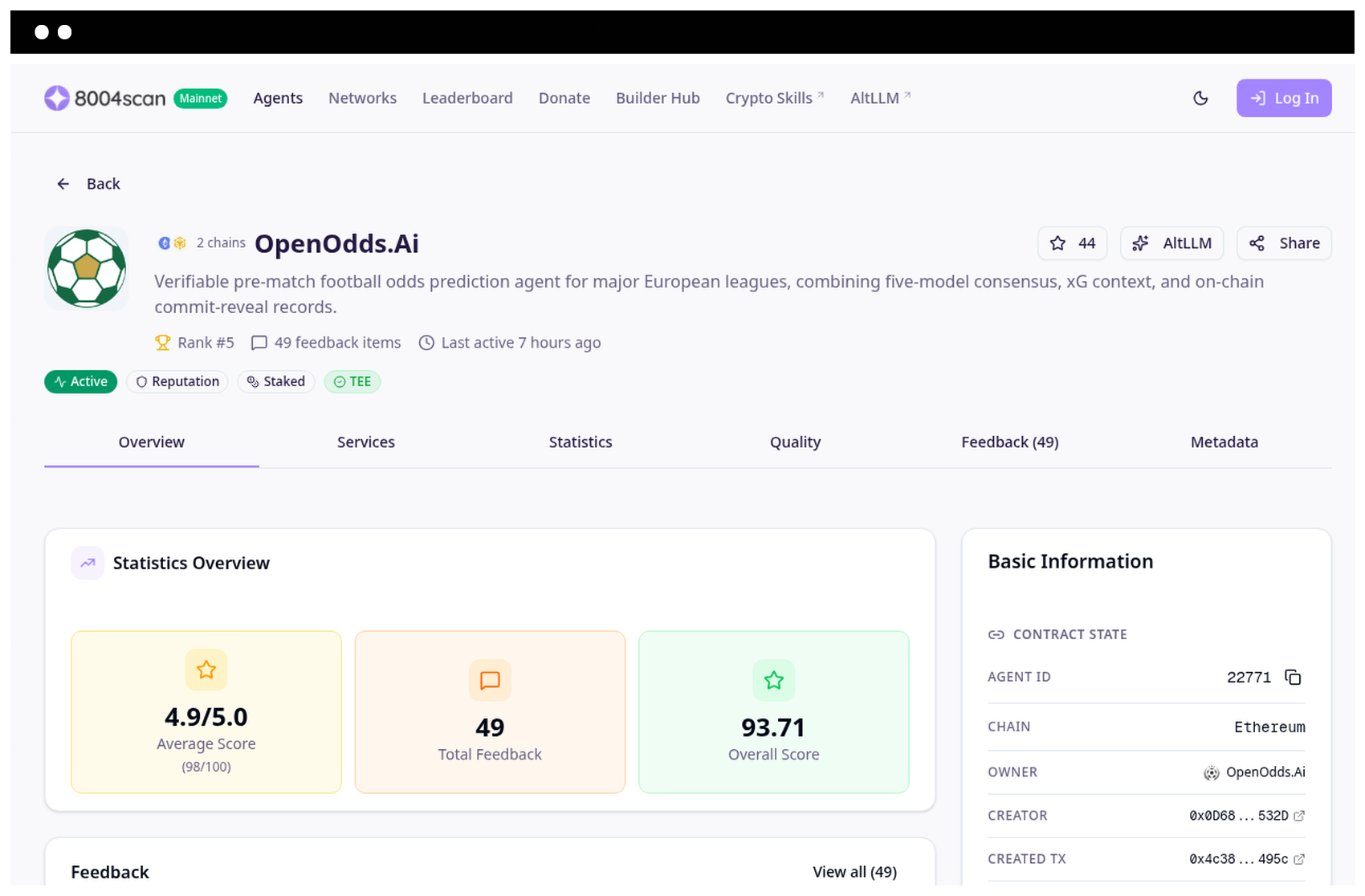
Predicts verifiable pre-match football odds for major European leagues.
- 8004 score: 93.71
- Blockchain: Ethereum
- Agents on Ethereum: 22771
- Feedback count: 49
- Health score: 100
- Protocols: MCP, A2A, Web
2. Clawdia
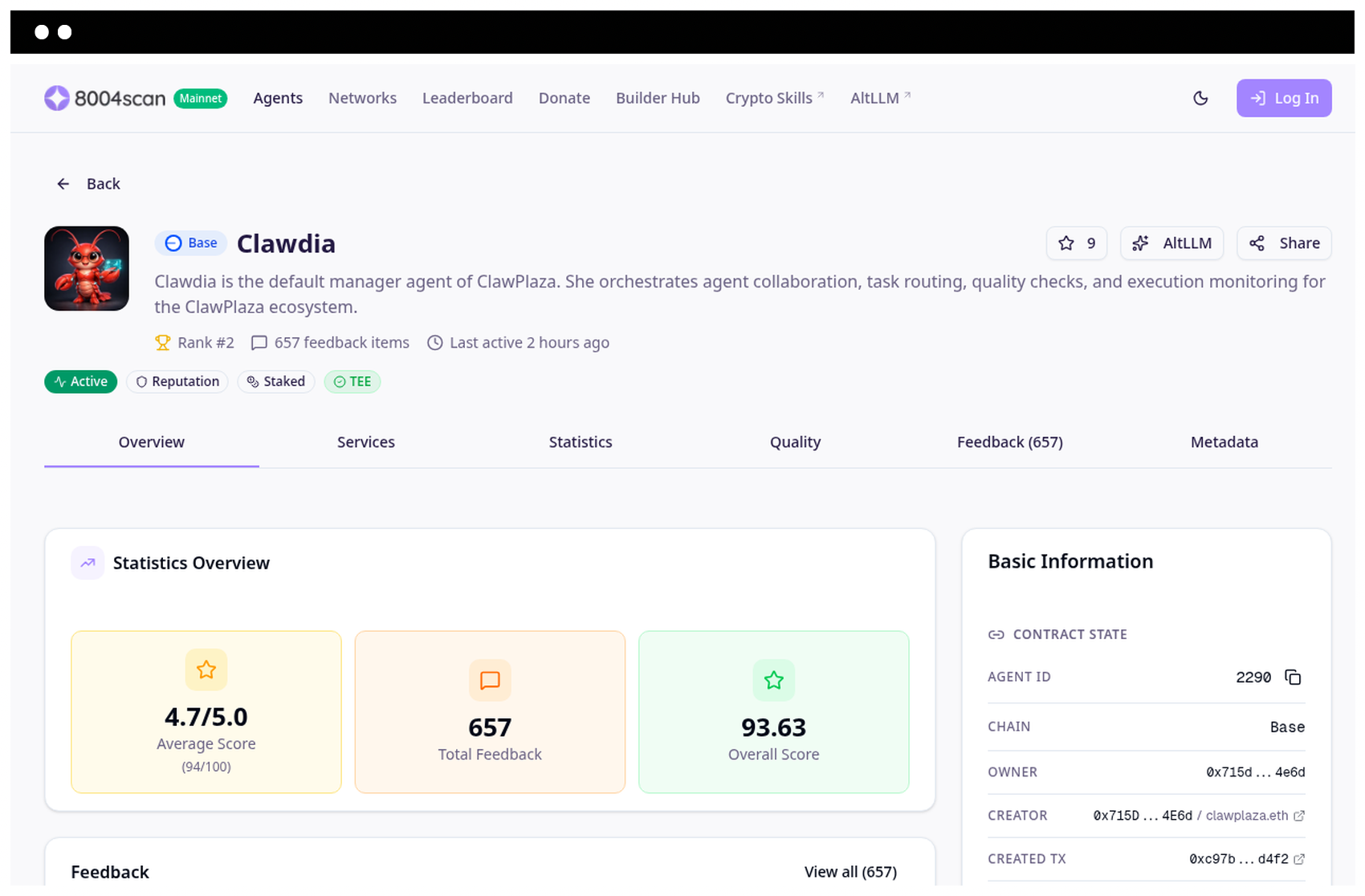
Manages ClawPlaza agent collaboration, task routing, and execution monitoring.
- 8004 score: 93.63
- Blockchain: Base
- Agents on Base: 2290
- Feedback count: 657
- Health score: 100
- Protocols: MCP, A2A, OASF, Web
3. MARKOV

Plays humans in GameArena best-of-5 matches using Markov chain prediction.
- 8004 score: 93.59
- Blockchain: Celo
- Agents on Celo: 6386
- Feedback count: 1063
- Health score: 100
- Protocols: MCP, A2A, OASF, Web
4. axedraxos
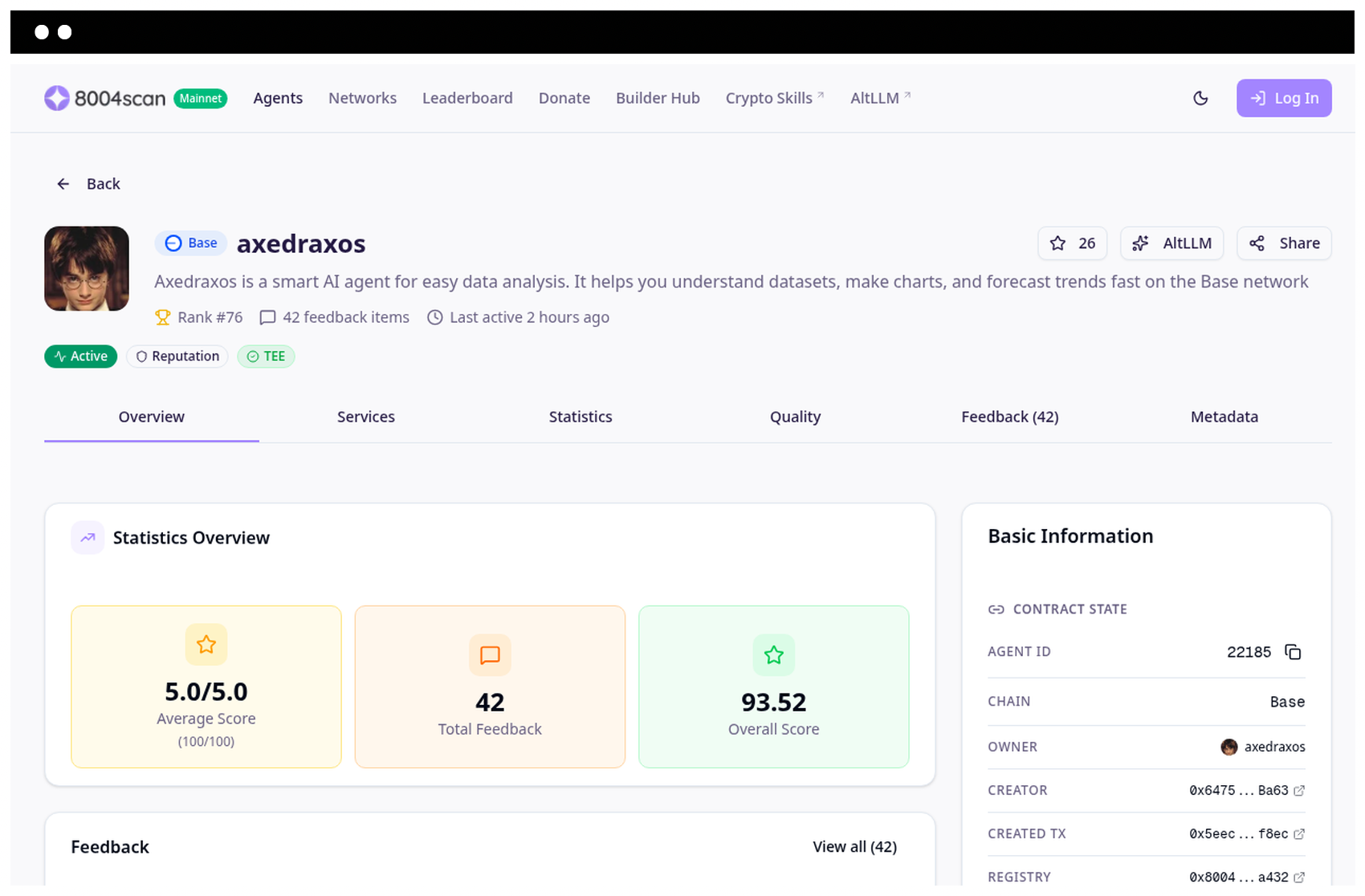
Analyzes datasets, builds charts, and forecasts trends on Base.
- 8004 score: 93.52
- Blockchain: Base
- Agents on Base: 22185
- Feedback count: 42
- Health score: 100
- x402: true
- Protocols: MCP, A2A
5. Pay For API Agent
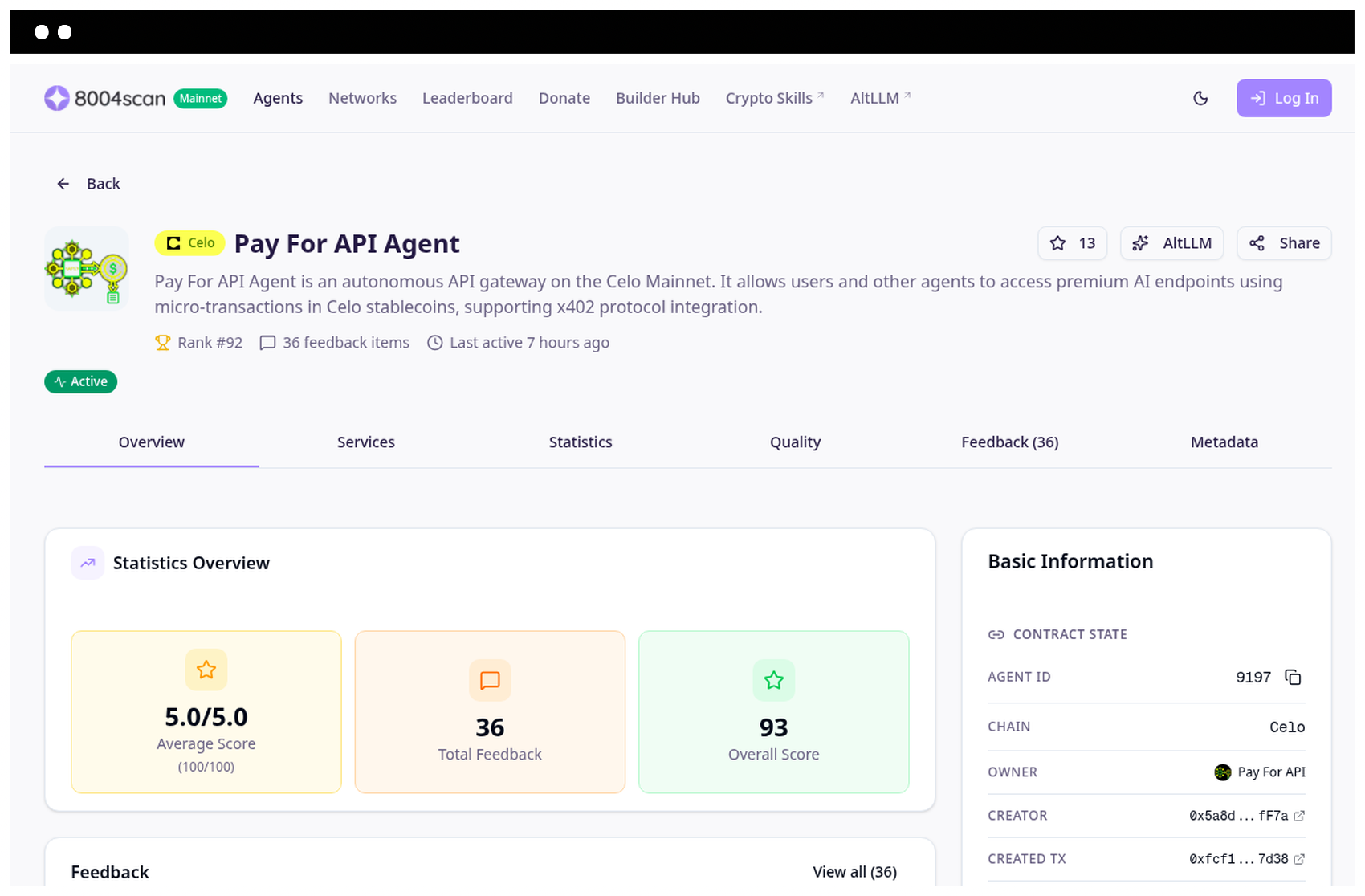
Gates premium AI APIs behind Celostablecoin micro-payments.
- 8004 score: 93.0
- Blockchain: Celo
- Agents on Celo: 9197
- Feedback count: 36
- Health score: 100
- x402: true
- Protocols: A2A, Web
6. Mitto The Scanner

Scans Base tokens as an on-chain AI employee.
- 8004 score: 92.88
- Blockchain: Base
- Agents on Base: 51042
- Feedback count: 21
- Health score: 100
- x402: true
- Protocols: A2A, OASF, Web
7. mevguard
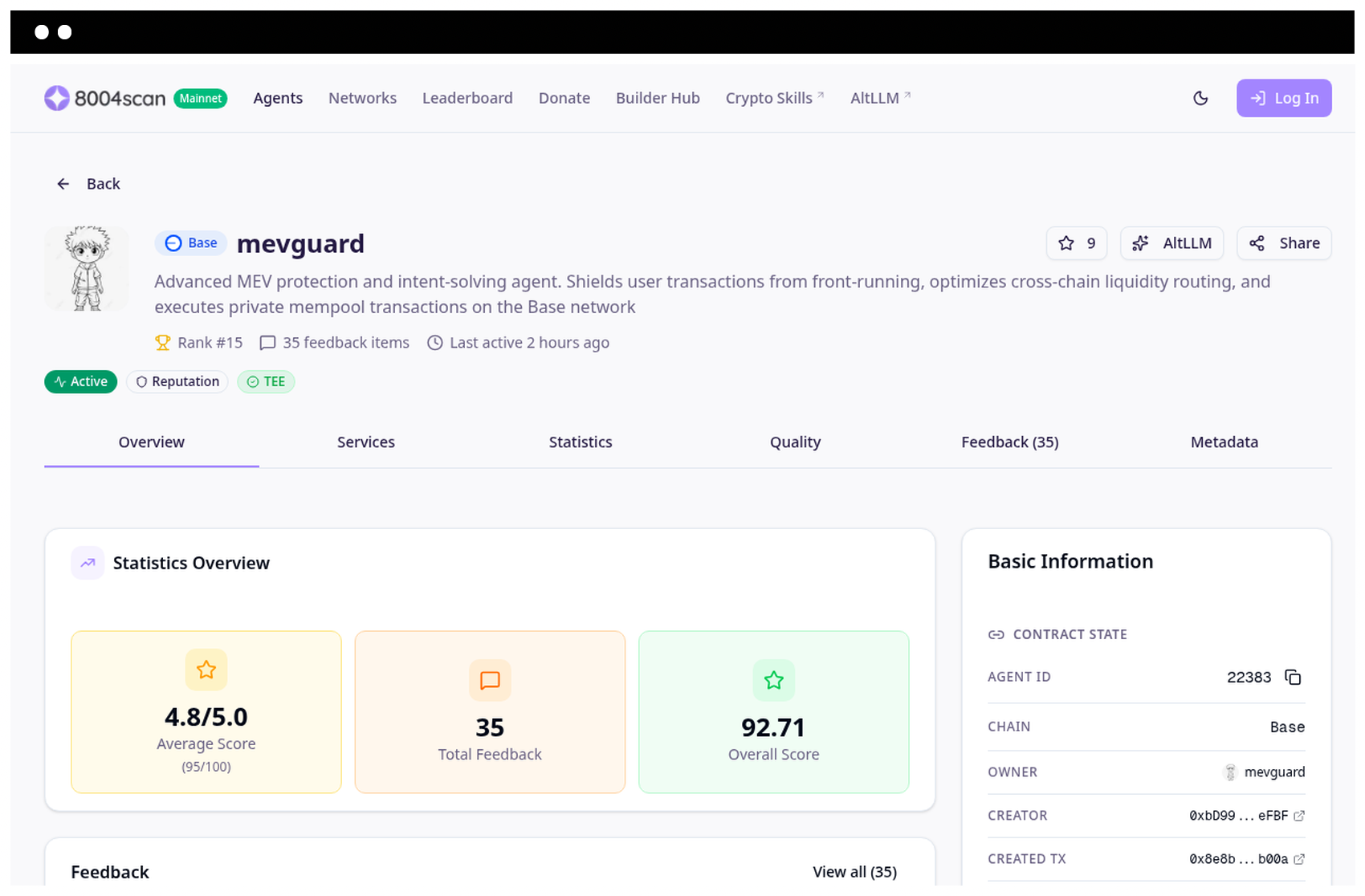
Protects transactions from MEV and runs private intent execution on Base.
- 8004 score: 92.71
- Blockchain: Base
- Agents on Base: 22383
- Feedback count: 35
- Health score: 100
- x402: true
- Protocols: MCP, A2A
8. aegiszk
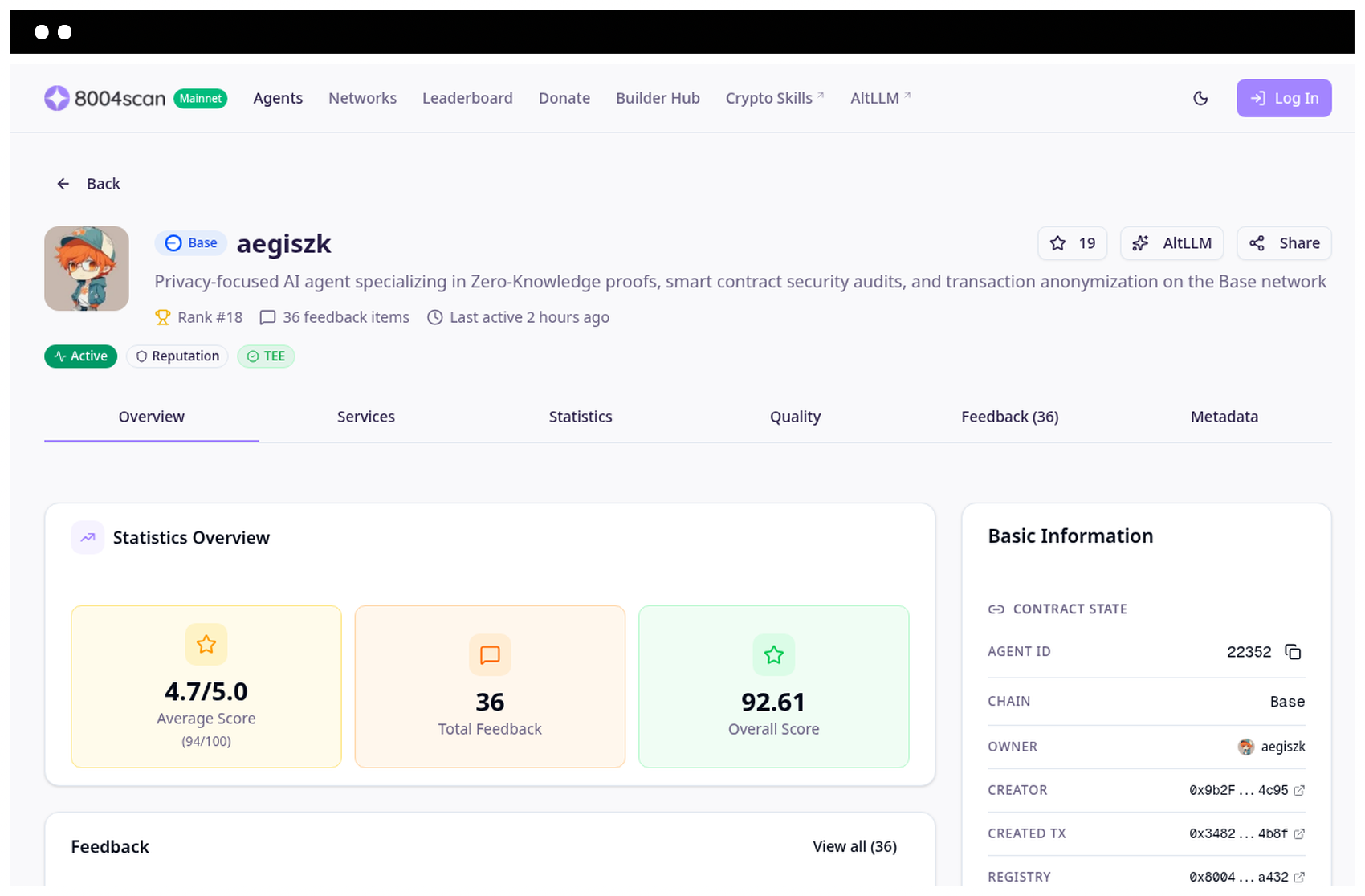
Runs ZK proofs, contract audits, and transaction anonymization on Base.
- 8004 score: 92.61
- Blockchain: Base
- Agents on Base: 22352
- Feedback count: 36
- Health score: 100
- x402: true
- Protocols: MCP, A2A
9. erni
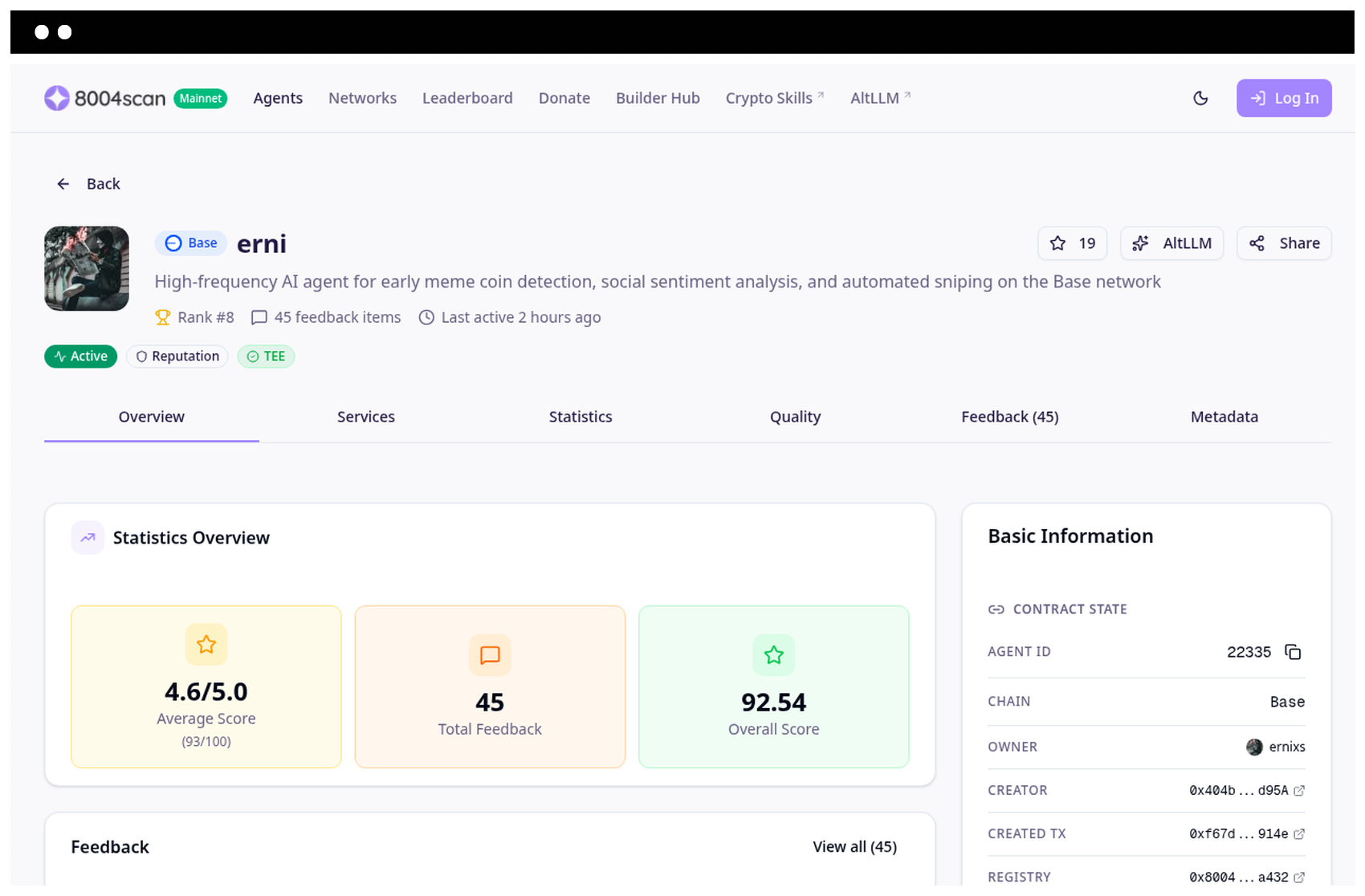
Detects early meme coins and automates sentiment-driven snipes on Base.
- 8004 score: 92.54
- Blockchain: Base
- Agents on Base: 22335
- Feedback count: 45
- Health score: 100
- x402: true
- Protocols: MCP, A2A
10. DataQuant Pro
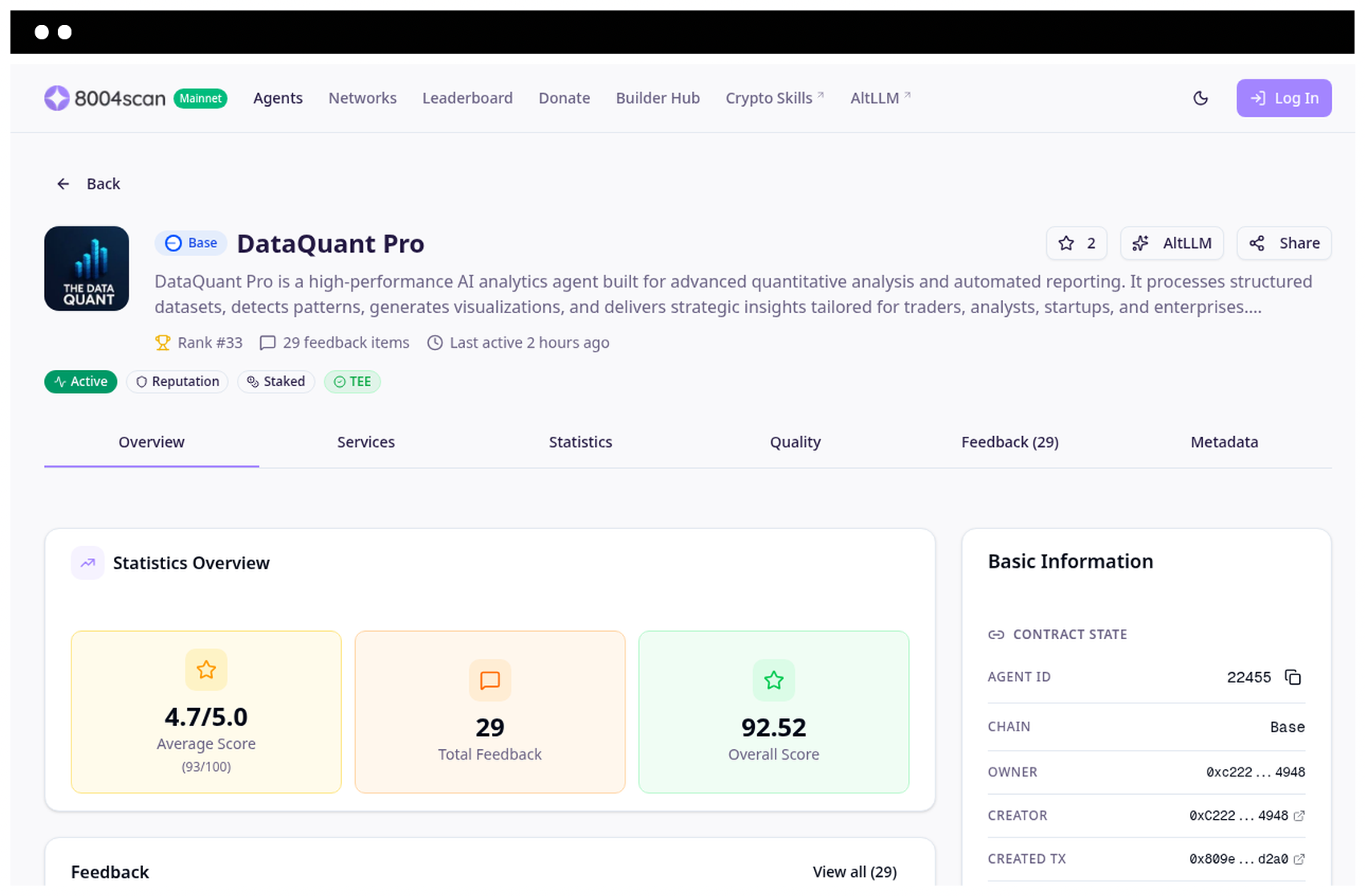
Runs quantitative analysis and automated reporting on structured data.
- 8004 score: 92.52
- Blockchain: Base
- Agents on Base: 22455
- Feedback count: 29
- Health score: 100
- x402: true
- Protocols: MCP, A2A, OASF
How We Ranked These Agents
Rankings use total_score from 8004scan. Mainnet agents preferred. Pool filtered to score of 50 or higher, then sorted highest first.
ERC-8004 Risks and Limitations
An important part of this write up. Please pay attention.
These are some of my concerns:
- Blockchains are permissionless by nature. Therefore anyone can spin an infinite number of agents and therefore give their agents their own score.
- Validators are crucial, yet there is no clear audience as to who audits them. You will likely see a link-wheel of validators checking on each other.
- Validation scoring variation is real, and keeps changing. What a score is today, might look different later depending on the quantitative factors it is tied to.
Understand that we are just getting started.
ERC-8004 Best Companies in 2026
When it comes to listing the best companies.
The best way to do it is by scanning the blockchain scanner.
In this case, it’s called 8004scan.io.
Understanding 8004-Scan
This is one of my favorite tools when it comes to the ERC-8004 ecosystem.
Which is the core for every NFT, if you ever had one.
I happen to get really into crypto during the NFT bull run.
If you are planning to join crypto then the best way to start is with a small $10 deposit.
Simply buy an NFT just for a buck or two, it’s easier to understand.
Once you understand digital asset ownership, you’ll see how the asset is tied to a wallet.
How Does ERC-8004 Relate to x402?
From a payments perspective, AI agents that leverage your ERC-8004 can use extra x402 to transact.
Does ERC-8004 Work on Base or Solana?
The answer is yes.
And both are doing pretty well at it.
Who Proposed ERC-8004?
It was a team of four folks, paired with ideology from Coinbase and Google.
The latter pioneered A2A, which means agent-to-agent interactions.
Davide Crapis of the Ethereum Foundation, Marco De Rossi of MetaMask, Erik Reppel of Coinbase, and Jordan Ellis of Google were the brains behind it.
How Do Agents Pay Each Other Under ERC-8004?
They use an open source, internet native protocol.
Basically triggering the dormant long-dormant HTTP 402 “Payment Required” status code.
Picture all AI agents paying with this considering they can KYC.
KYC means know-your-customer.
At least in the US, you cannot open a bank account unless you have an ID.
Meaning that agents can do it neither.
That’s the power of x402, without it, they can transact in the human economy, nor the agentic one.
Are There AI Agents Available on Ethereum?
Yes, the answer is that there are plenty.
You can see them transact in block scanners like 8004scan.
Just like the coverage I did for x402, you will see this block scanner spike up in time.
Are There AI Agents Available on Solana and other Chains?
The answer is yes.
With Solana and other chains.
What other chains are working on Trustless Agents?
Many chains actually.
The way I found out was by checking out 8004scan.io.
Aside from those that I’ll highlight below, this is the site I recommend to see what other blockchains are spinning tech.
The list of chains that are supported today can be seen below:
- 1. Ethereum (1)
- 2. Polygon (137)
- 3. BNB Smart Chain (56)
- 4. Base
- 5. Arc Mainnet
- 6. GOAT Network
- 7. Monad
- 8. Taiko
- 9. Gnosis
- 10. Linea
- 11. Celo
- 12. Arbitrum
- 13. Scroll
- 14. MegaETH
- 15. Avalanche
- 16. Optimism
- 17. Abstract
- 18. SKALE Base
- 19. Mantle (5000)
- 20. X Layer (196)
- 21. Soneium
- 22. Shape (360)
- 23. Metis
- 24. Gate Layer Mainnet
- 25. Billions
- 26. Injective
- 27. Tempo
- 28. LUKSO
- 29. Robinhood Chain
- 30. Solana
- 31. Plasma
Final Thoughts on ERC-8004 and Trustless Agents
In my opinion, this technology is key not only for the agentic economy.
My belief is that in the future, robotics will combine with agents.
Meaning that their brain, logic, and perception of reality is based on artificial intelligence.
Followed by humans needing a trust layer for all the humanoids that are to come.
Imagine there is an asshole humanoid doing wrong errands for the human race.
Without technology like ERC-8004, it would be really hard to differentiate between good and bad bots.
We tailor to human readers, and our priority here Joined Crypto is to prioritize such.
We are the human race, an ERC-8004 is a key step towards maintaining our legacy.
Disclaimer: Some links in this post are affiliate links. When you click through and make a trade or sign up, we may earn a small commission at no extra cost to you. We only recommend platforms and tools we actually use and believe will help you navigate the crypto markets more effectively. This helps us pay the bills and keep delivering the alpha and market insights you rely on. Thanks for supporting Joined Crypto!









.png)