What Is a Cryptocurrency Payment Gateway?
Well, let’s get something clear here.
If you have ever bought anything in today’s day and age, let’s say a cup of coffee, then you have used a payment gateway company to transact.
So, the point here for this article is not to necessarily talk about the payment gateway or the point of sale (POS).
We are here to talk about the companies that work behind the scenes.
Those that can help you catch up to top players like Stripe, Toast, Square, Lightspeed, Clover, Shopify POS, and more.
To me, stablecoins and payments are the moat that crypto has to follow.
Imagine the entire planet starts seeing Americans interact with crypto payments. This would trigger a chain reaction around the world.
Not like it’s easy to pull off, though.
The funny thing is that if you are into crypto, you can easily pull an ROI calculator on any small business that processes micro-transactions and prove that they can cut costs.
The calculator above should be sufficient to tell you that if you are into crypto merchant payments, there is a massive opportunity here.
It’s a top item on the list for entrepreneurs applying to the Solana Incubator.
For me, this writing is a fun one. Simply because I spend an unhealthy amount of money at coffee shops, drinking one too many.
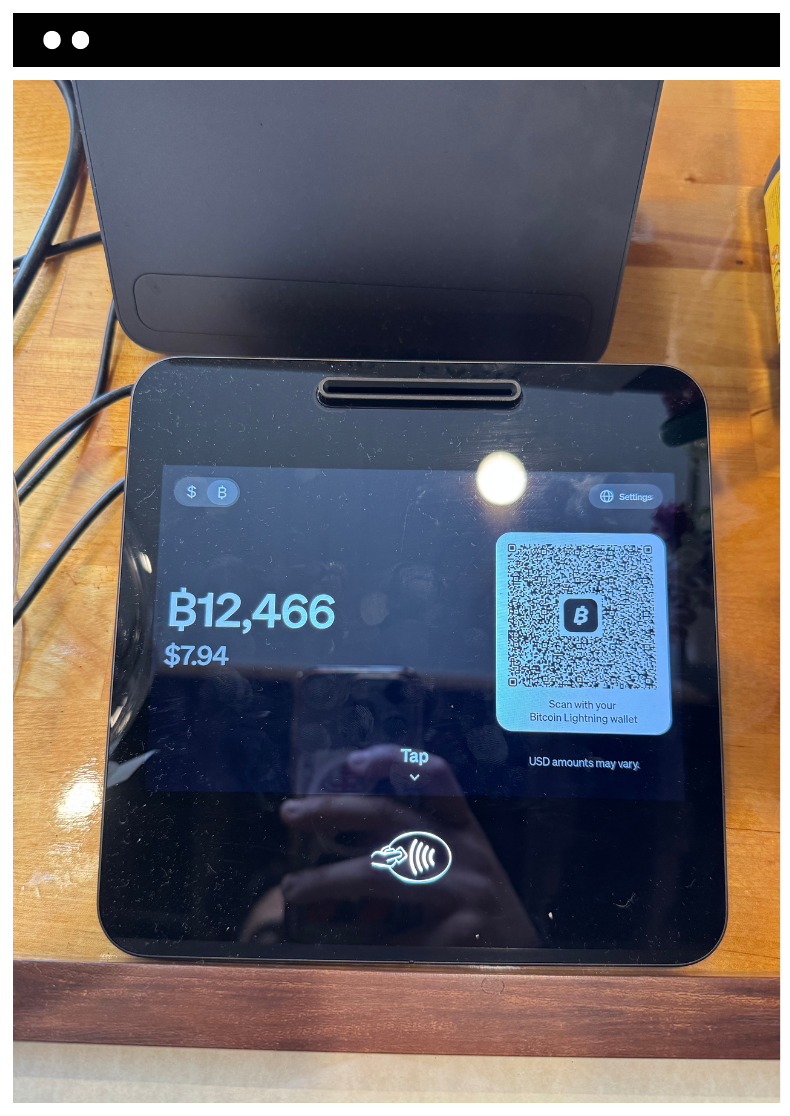
You are probably familiar with the Toast point-of-sale. I see this everywhere, from coffee shops to restaurants and bars.

Look at it closely. You can clearly see that you can pay with Bitcoin or cash/fiat USD.
In my opinion, a chain like Bitcoin or Ethereum does not match today’s customer expectations.
For instance, just to buy this coffee at one of my favorite coffee shops in Chamblee, Georgia, called Kin Coffee, I tried to bridge USDC on ETH to BTC through Near Intents, while also doing another small on-ramp transaction from my centralized exchange.
Both transactions took more than 20 minutes to process and hit my wallet. Does that sound like the future of finance to you?
Well, not to me.
Little did I know that the best way to interact with what I consider the best fintech payment gateway, Toast, is to pair it with a CashApp account.
There are probably a thousand ways to pay with BTC nowadays, but I see Toast everywhere.
So there's no way to go around it. They deliver a great product for both traditional fintech users and your typical mom and pop, with great hardware, and serving most of the market.
Matching the market is a straightforward play, but testing this out before building a crypto payment yourself is key.
People who know me can tell that I’m skeptical of all chains, including Bitcoin. I need to be impartial at the end of the day.
I look forward to seeing Toast competitors accept more chains.
This can seriously boost crypto adoption, and perhaps it can be your moat to obtain part of the market.
On the other hand, I paid for this coffee using CashApp, and had my usual at Kin Coffee, a double espresso cappuccino, to-go.

The transaction was lightning fast, no pun intended.
But it makes you wonder how they process it: does the gateway push the transaction on-chain right away, or do they host it in a decentralized fashion?
Perhaps they process their own transaction with their liquidity pools and market makers?
All fair questions, and items we will discuss shortly.
Let’s dive in, and feel free to jump where needed with the outline below.
- What Is a Cryptocurrency Payment Gateway?
- Why is it a Win-Win for Vendors and Consumers?
- Build vs. Buy: Do You Need Custom Development?
- Key Features Every Development Company Should Deliver
- Customer Support
- How to Evaluate a Cryptocurrency Payment Gateway Development Company
- Cryptocurrency Payment Gateway Development Company Spotlight (2026): Suffescom Solutions
- Cost to Develop a Crypto Payment Gateway
- Common Mistakes Businesses Make When Hiring a Development Partner
- Frequently Asked Questions (FAQ)
- What Cryptocurrency Payment Gateway Development Companies are Doing for the web3 Industry
Why Is It a Win-Win for Vendors and Consumers?
How It Differs From a Traditional Payment Gateway
This is pretty straightforward.
The main difference is that one runs solely on fiat/cash, and the other on crypto.
A blockchain payment gateway removes the usual payment gateway and runs entirely on-chain.
Now, the other part here is that the revenue spreads for the payment gateway fiat/cash companies are sizable compared to crypto.
Yet, as a crypto native. I can tell you firsthand that crypto runs in a compliance-less environment fit for innovation, while the TradFi and fiat-based fintechs dwell in their local jurisdiction and consumer protections.
Core Components
All payment gateways operate with an established set of components.
Obvious outliers depend on the project, but stick to these by principle.
You are always one call away from figuring out the proper scope for your project. Luckily, we have a set of vendors below to help you make the toughest call.
Wallet Layer
We have two types of routes here.
If you plan to build a custodial-oriented payment gateway, then we are talking about the gateway company holding the keys for your customer.
This can then turn into a logistics challenge in terms of redistributing assets across vendors and their customers.
Non-custodial setups differ to an extent. The key element here is that the vendors hold the keys.
I’ve given this some thought. Perhaps the best thing here is to really bond with a good vendor that can help you with the heavy lifting.
As a growth person, I’d rather ensure product value and shoot for market fit with enough marketing spend. With revenue, you can always revamp.
Different needs for different clients, but a key part of how.
Blockchain Nodes
In this case, once you define the chains you want to support, the next step is to understand whether your nodes will be self-hosted, hybrid, or third-party.
In my experience as a retail user, especially using better RPCs to front-run transactions, I believe that opting for a third-party RPC is what makes most sense here.
Especially since powerhouses like MetaMask and Phantom allow custom RPCs, which I’ve tested.
The ones I’ve heard of include Alchemy, Infura, Quicknode, and Helius. I would mention these to your engineers and product folks.
Solana recently launched a dashboard to analyze their performance.
Being multi-chain can be a route you are interested in. Just note that for the most part, each chain usually requires a single, specialized RPC to operate.
If you were to go to your MetaMask wallet, for instance, you will find that it is really easy to change your stock RPC with another powerhouse provider, or simply opt for something more custom.
Take the above and see it through a crypto payment gateway lens. Give yourself the option to swap the RPCs in case there are issues. That way your transactions get processed non-stop.
Conversion Engine
As of today, I can safely say that a typical retail customer is not ready to pay with crypto, whether it is with Bitcoin, stablecoins, or something else.
Yet, the tides are shifting.
Payroll companies and even corporate cards are starting to run on crypto. Therefore, the obvious next step is to enable crypto payments.
On the other hand, vendors want it swapped into local cash, government-issued USD, almost instantly. A clean fiat to crypto conversion of sorts. Something they can send straight to the bank, or at least stablecoins that are pegged to fiat.
So, can a crypto payment gateway convert to fiat? The short answer is yes.
In my opinion, not picking a fast chain is ludicrous.
“I’ve never seen anyone be satisfied after waiting 2 minutes for a crypto transaction to settle.”
The role of price oracles is another thing. Once you pick a chain, you must find an adequate oracle to feed you real-time pricing on the crypto you accept in your gateway or POS.
The oracle companies I see doing a great job include Chainlink and Pyth.
Alternatively, you must source pricing via an API, which can be disastrous if they are not matching the rates of other oracles. A single point of failure situation, to say the least.
The biggest challenge I see when it comes to conversion engines is the liquidity routing and slippage part.
Picture you execute a payment settlement with a customer, yet you do not have the liquidity to cover it. Despite you serving such currency, you can’t actually accept the transaction. That sounds like a customer and a nightmare vendor to me.
The other challenging part is slippage. When your engine is slow, or with a bad dynamic fee function that executes the transaction at a different price due to volatility or through a poorly distributed order book. This will ultimately translate into a vendor loss, with the issue trickling to you, the crypto payment gateway vendor.
So, to counter liquidity and slippage issues, make sure to work with the right DEXs, market makers, or create adequate internal liquidity pools.
Merchant API
This is straightforward. There are simply tons of companies out there for crypto development that can help your team build this out.
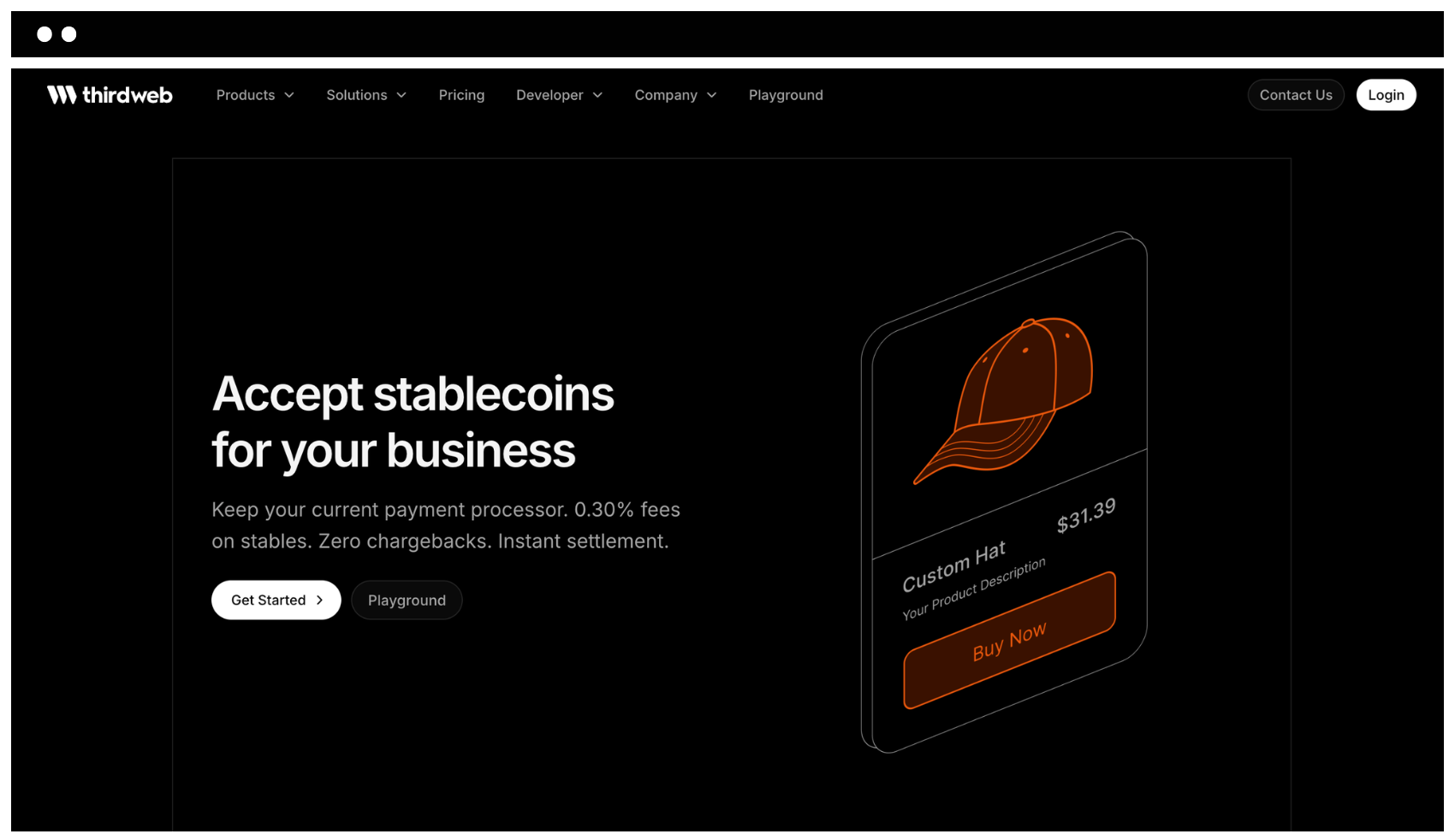
For instance, thirdweb is one of the most badass infrastructure companies I’ve ever seen in the space. They can help you build anything really, from marketplaces to crypto payment gateway software, and more. All with their easy-to-use SDKs.
Trust me, I understand that there is a need to counter cost dependencies from these third-party API providers, and developing your infra in-house might be appealing. I’ve just seen too many companies try it just to find out they are one or two core blockchain updates away from depleting their runway.
Keep your cost slim, fire your webhooks fast, and focus on using user-tested APIs ready to do the deed for you and your customers.
Also, if you are building a cryptocurrency payment gateway company, ensure again you have enough runway to market this thing.
As a growth dude, I’ll always remind you.
“No traffic, no party.”
At a minimum, you need your product engineering to fire at speed and with cost that benchmarks the market rate.
Yet, people forget that if you do not have traffic at all, your webhook APIs won't fire anyway, meaning that they created no cost.
So, if you have no traffic and no API webhooks firing, then do not bother about this. Not worth it anyway.
Build vs. Buy: Do You Need Custom Development?
When a White-Label Gateway Is Enough
You tell me.
That’s a question for the entrepreneur or for the private company looking to expand the number of currencies that they accept.
Considering crypto payments are on the come-up, might as well think it through.
A white label crypto payment gateway is often the smartest choice here. And even your developers won’t recommend you reinvent the wheel. It would trigger an acquisition issue to market something that prospects are not familiar with.

Note how the chart is up and to the right, just the way I like it.
And, as mentioned before, payments are the one thing having a great product-market fit (PMF).
If you did not give the ROI calculator a go, then give it a shot.
Then, ask yourself:
“How much would my local coffee shop save and benefit from this implementation?”
When Custom Development Makes Sense
I would not even consider developing a custom crypto payment gateway if you do not have a market for it.
No crypto users around you physically means no business, or even users to stress test your product.
Considering it’s a payment gateway, there's no need for intricate development.
So, instead of wiping your business cash runway clean without any customer traction, ensure that white-label investment has compiled enough transactions (txns) to see an ROI on your effort in the future.
Regulatory Licensing Edge Cases
Hear me out here, I am not a legal counsel or an expert by any means.
My management senses tell me that it is best to opt for professionals who know how to handle this.
That’s without saying that the vendors suggested on this list know what’s up. So without a doubt, prioritize touching base with them on this.
In fact, one of the key things my friends at Suffescom Solutions mentioned during our Q&A was that this was a key element of any build, especially if you want anything in fintech.
Even I had to face the compliance hurdles that plague this industry. One slip here and you are done. You are one mistake away from burning your runway.
Here at Joined Crypto, we are not big fans of the EU at the moment. A region plagued with compliance complications. Even the recent MiCA rollout sounds like another roadblock for innovation.
Please don’t take it personally if you are offended by this. At the moment, the USA and Asia are ahead in the crypto game.
Money Transmitter Licenses (MTL), for instance, are relevant to each state in the USA.
The U.S. Treasury's Office of Foreign Assets Control (OFAC) does blacklist and penalize businesses, entities, and individual folks. They handle their own party list to ensure that no malicious groups are handling US dollar transactions with sanctioned countries or terrorists.
High-Volume or Proprietary Settlement Logic
Another conversation for your developer team.
In my experience, I’d rather have everything run on a high-volume chain from the start. Solana, BNB Chain, and even Layer 2 EVM blockchains like Base or Polygon.
I’d say that another important thing to match with a high-volume chain is a strong RPC provider. Alchemy, Infura, Quicknode, just to name a few.
Your front end will capture the data and either process it leveraging batching, basically what L2’s do today. You can look into how Base operates in tandem with Optimism’s EVM technology. That’s more or less how they run their ops to process txns at scale.
Batching is an option when things really take off, and you offload part of the transactions on a centralized database. That’s how I understand it, in most cases at least. This needs to be pushed on-chain later so it enters the ledger.
The conversation here is to figure out which route you like best. The high-volume chain route or a proprietary batching configuration.
It would not be a crypto payment gateway anyway.
Netting is also an interesting approach. If you are doing outbound and inbound payments at scale, and fast, then you could opt to build optimized smart infra where internal liquidity pools come into play to sustain operations at this level.
As an afterthought, if you do not have the funds needed to build a long-lasting tech business, then you are probably looking to build a mom-and-pop-style operation.
Nothing wrong with it, but note you will look bizarre to your customers as they face your custom build.
Don’t be so custom it's confusing. It’s funny, yes, but it happens.
You should be specific in terms of the TPS and volume you are expected to handle. One thing is opening a small op in Da Nang, Vietnam, and another is launching in Bowery, New York City.
Next, obviously ensure proper data is in place, especially if you use custom settlement logic and processing. Capture queuing, rate limiting, or documented outages, and beyond.
Lastly, multi-chain factoring and reconciliation are pretty important. You are handling money, digital assets, all that hold a tangible value.
One hidden mistake here can screw up your books, and as you may already know, if this isn't your first entrepreneurship rodeo, this can translate into important costs.
Key Features Every Development Company Should Deliver
If I were in your shoes, the first thing I would prioritize as I enter this crypto payment gateway space is to benchmark your competitors and, at a minimum, match them.
Basically, your minimum viable product should match the standard.
I cannot write this any simpler, nor mention how important this is, and how overlooked.
As a fun analogy, don’t be the dude that built car seats on the roof of the car, or a dashboard that is just for left-handed folks. For your own sake, stick to what people know, which will require less education, and you can quickly deploy go-to-market (GTM) campaigns.
Do not reinvent the wheel in terms of infra, tech stack, UX/UI, chain support, and beyond.
At a minimum, you should aim to match your competition and cannibalize their market. Once you acquire a strong list of customers, then it’s time to reconsider fundraising, bootstrapping, or any other venue you might see fit.
If you are at a very early stage and are interested in working with Solana, glance at the Superteam. These folks can help you a ton to break into the industry, have traction, and network. On top of that, saving the best for last, they will give you funding without taking a single share of equity.
If they like you, you get money, for free basically. No strings attached.
Multi-Chain and Multi-Currency Support
This is straightforward and has been discussed earlier in this post.
Understanding your market is the first step to figuring this out. Let’s say you want to address the APAC market with your crypto payment gateway company. Then prioritizing a chain like Binance SmartChain (BNB) or Tron (TRON) could be more fruitful than their counterparts.
Same if you are in the USA. Then consider chains like Base, the Coinbase-led L2 chain, or Solana’s or XRP’s L1s.
If you are not careful aligning your market with the right chain, your project might have its days numbered anyway.
Pay attention, because no matter the vendor you hire to help you build your crypto payment gateway, they simply will not object more than once or twice. Followed by an “I told you so…” when your gateway has no product market fit (PMF), or traction whatsoever.
Wallet Integration: Custodial vs. Non-Custodial
We broke down the main differences between a custodial and non-custodial wallet. The latter can also be called a self-custody wallet. Be careful distinguishing the differences here.
In terms of the main difference here, note that a typical custodial wallet setup involves the development company holding your assets.
On the other hand, the non-custodial wallet setup gives the vendor complete access to their funds. But also delivers a taxable responsibility that separates from the original vendor or developer.
Also, a non-custodial wallet suffers from theft scenarios, especially from managers who do not keep their private keys secure. Picture a multi-sig scenario, for instance, where multiple keys are used to secure your funds.
Last but not least, ensure your cryptocurrency payment gateway company includes compatibility with a variety of wallets among the most popular chains.
A payment gateway integration that supports top-tier self-custody (or non-custodial) wallets like MetaMask, Rainbow, and Phantom is core to a great UX experience today.
One company I think is worth checking out is WalletConnect.
At Cogni, a neobank and non-custodial wallet company I worked for. We developed a good sign-in system to log in with the Cogni wallet onto any dApp.
And you guessed it, it was multichain, ready to accept sign-ins from numerous blockchains, and also included WalletConnect.
If you need to tune into which crypto wallets are doing well, check out our piece about the best NFT wallets out there.
Real-Time Conversion and Volatility Protection
There is a particular relationship between the real-time conversion engine and risk.
An interesting element to consider here is price locks, which counter slippage issues. Remember that crypto moves fast, and even stablecoins might depeg by a single cent for a very short amount of time.
In this case, remember that whatever the difference is, someone is going to pay it. It will be the vendor offering you some sort of insurance, an insurance or volatility protection product, to fund the txn quickly.
Perhaps they route work through market makers, something that you need to double-check on your own, and figure out what is best.
Security and Compliance
Well, let’s just say that you should do your own diligence.
Asking your vendor for a history report is the first step, obviously.
So, perhaps it is best to ask folks like Arkham, CertiK, Trail of Bits, OpenZeppelin, or any equivalent.
Find contracts or builds they have done, and then run them through these crypto auditors.
It’s as easy as asking one of the vendors.
In terms of custodial security, browse your options in terms of multisig, MPC (multi-party computation), or hardware security modules (HSMs).
AML/KYC Integration
A compliance need is more than a data collection item.
You can verify these folks yourself, or with a third-party vendor. Like everything else, so no surprise.
Just for the love of god, do not be cheap on this.
There is literally no fintech company that isn't trying to get gamed by your favorite Nigerian prince.
Galileo, for instance, was a tool we used at Cogni for KYC and even AML, countering money laundering and fraud.
PCI-Adjacent Security Standards For Crypto
Payment Card Industry Data Security Standard (PCI-DSS) is the use of encryption mechanisms to hide, hash, and encrypt through algorithms, ensuring your crypto transaction volume processes safely. You cannot compromise cardholder data, period.
The use of strong encryption algorithms, hashing, and cryptographic key management to protect important cardholder data.
It does not refer to cryptocurrency or blockchain assets unless a crypto payment processor is processing traditional credit or debit card payments.
Smart Contract Audits
Opt for a good auditor to check your build and if you are questioning your build, refer to Arkham, CertiK, Trail of Bits, and OpenZeppelin are good companies to start with.
Keep an eye on these three items in your smart contract:
- Data at rest must be hashed, encrypted, anonymous, and secure
- Data in transit, such as card data moving in public networks
- Cryptographic key management is crucial because you can quickly lose your assets in one pull if you are not careful. You are always a hack away from trashing your treasury. This is where multi-sigs come into place
Other things worth mentioning to your developer include their experience with SOC 2 Type II certification. How they QA penetration testing cadence, and their approach to data encryption and tokenization in practice.
Settlement Speed and Chain Selection
Honestly, this is not hard to figure out on your own.
Take Chainspect, for instance. They provide live data you can show your developer and make a team decision on where to build first.
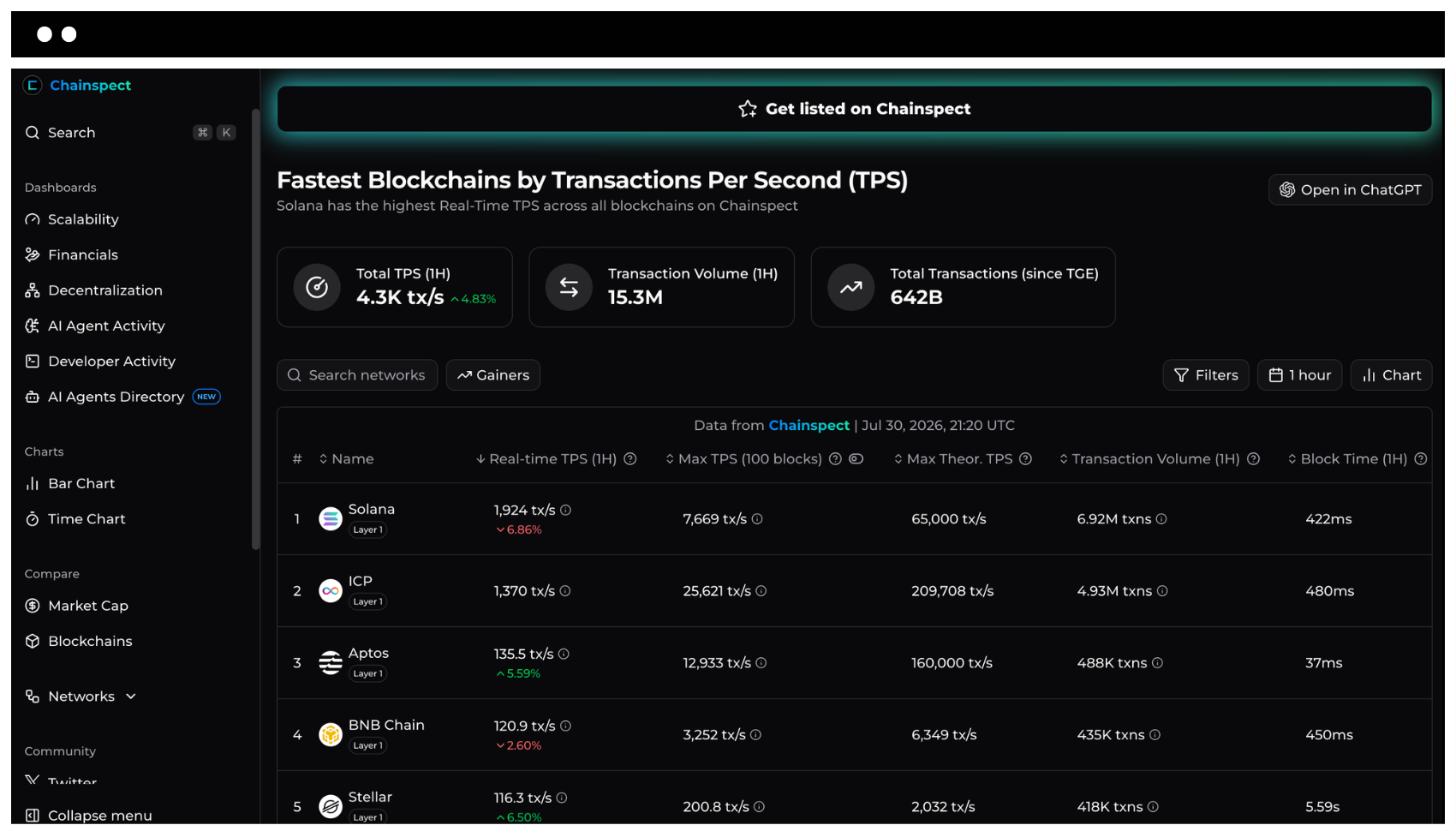
If your chain of choice does not have users, then do not expect much volume behind it.
Another interesting thing I learned from being in this space for years, and attending hackathons and the such, is that you can easily scout grants.
Especially from new blockchains launching their grants to push their go-to-market (GTM) campaigns.
After leaving the Solana Hackerhouse, I met some interesting dudes that showed me how they would go around the world chasing these developer grants.
That experience steered me towards Near Protocol, a blockchain I’m fond of, and it’s fast.
I had to verify it, because I found it too good to be true. Most folks that do this simply spin off whatever the top chains' dApps are doing, and do it where the grant opportunity is, scoring them money to build it, live off it, and shoot for the next one.
I’m the dude with the black hat, by the way.
API and SDK Quality
If this is your first tech company, then know that an API is just a connector to another data provider or cloud software that triggers an action.
And an SDK works similarly, especially for those working on mobile-ready products.
Ensure the docs are good too.
I’ll give you a tip here: if you run any of the APIs and SDKs that you are planning to work with on SEMrush, you will realize which are the top pages being searched.
“And you can either hone in on those, or realize that’s where most devs are failing. This either shows where the real bangers are on the doc, or where the provider is doing a total bust.”
Additionally, a proper sandbox or test net is key to deploy in prod. Again, if you pick a chain that sucks, or software in general, then you will probably figure it out by seeing that their test environments are at fault.
Just ensure these companies actually update the docs, and you don’t see a keyword search spike where it fails. Else move on to the next.
Customer Support
Customer support, despite how boring it may sound, might be the one thing I recommend the most as you kick off your crypto payment company.
The lesson comes from my father, actually. Someone who gained an international dealer license to offer software to companies in LATAM.
The important part here is that he kept seeing how LATAM companies would have all sorts of unexpected issues from their localities, and also with their implementation as well.
He noticed that offering a robust customer support service was not only going to give him a profitable business, but it was also simply an almost mandatory requirement for these companies to survive their turbulent times.
My two cents here is that being stingy on the customer support bill can be disastrous, especially for brand new founders in any space or industry, really.
If the project runaway is tight, and your team lacks experience in the market, then I’d rather suggest going for a more affordable developer.
One that can get on the phone quickly to put out a fire, anytime, anywhere.
How to Evaluate a Cryptocurrency Payment Gateway Development Company
Track Record and Live Case Studies
Let’s keep it simple here.
The proof is in the pudding. I hate this phrase, by the way, but I assure you it will come in handy.
Some of the vendors we have curated have mentioned their portfolio companies.
Give them a shot. It all starts with a simple call to understand they have serious chops.
Otherwise, they would have never been featured here.
Security Audit History
When you pull up your favorite vendor, you need to do your due diligence.
I’d start with the auditing firms suggested before. These include CertiK, where I have a connection I met at a Uniswap event at Soho’s Ice Cream Museum.
Arkham, CertiK, Trail of Bits, and OpenZeppelin are companies I’d consider to audit the entire build.
Just call them early, show the roadmap, scope flaws, and be up front with them.
Be bold and tell them who you plan on hiring. We gave you some good options to start with.
If your company fails, remember it’s on you.
Post-Launch Support and SLAs
My dad was actually a master at this.
For instance, once a boutique vendor that does the job finds you, and it's a win-win, it’s typically because he is a phone call away.
Therefore, it really depends on the entrepreneur and product team, and the type of support you need here.
My dad, in this case, knew South American companies lacked the support they needed. Therefore, he capitalized on it and booked long-term, renewable support contracts.
The analogy here is that you can either go with the big developer companies and pray you can get the support you need, or consider paying up the bill with it. Or simply hire a boutique that picks up the phone on a Saturday.
Another time to remember is that vendor contracts can break you, and yes, your vendor will straight up take you to court when you owe $40k for two quarters straight.
Do not bite more than you chew.
When you see a Service Level Agreement (SLA), make sure you revise the timeline and small letters on it.
Send it to one of the law firms suggested on this post, and ensure you pass not only compliance, but also avoid any weird terms and conditions that might harm you in the long run.
Pricing Models
Honestly, this is not a part for me to speak much here.
Remember the graphic designer and revision analysis?
The more you screw up on the initial request, the more the bill will go up.
I’m confident that if these dudes see you scribble a lot, the cost per hour just on labor would spike.
Be serious with the runway you have before you blast it all on product and no traction.
Again, not something I want to discuss. Just speaking from a growth point of view.
At the end of the day, I’ve had to negotiate with plenty of vendors in the past.
Fixed-Scope vs. Time-And-Materials
A fixed scope is something that might be useful if you are planning to do a very basic or specialized build, perhaps an add-on.
A time-and-materials scope differs in terms of timeline parameters. Picture you working at scale and pairing up with a strong dev team.
That’s the type of synergy good investors want to see you handle.
Hidden Costs to Watch For
The only thing to watch here is yourself, not writing a proper Jira ticket for your devs.
I’ve worked with so many engineers that I know these fellas just want to build the impossible, obviously, because they are engineers.
“Any engineering major wants to build the Millennium Falcon.”
The whole point is that they will say that the sky is the limit, nothing is impossible, and anything similar.
Your job is to ensure revenue and optimize for scale.
Remember, less is more. Be laser-precise with your engineering tickets.
To me, the time and materials remind me of the timeline and quota framework.
Be descriptive, set up a timeline, and ensure your engineering team delivers.
If they are late, it’s their fault. You hired them. Now, fix it with simpler tickets, stacked, and managed by a proper timeline.
You are a Kanban chart away, paired with a little Kaizen philosophy, leadership, as you build the Millennium Falcon that actually pays the bills for you and your team.
Cryptocurrency Payment Gateway Development Company Spotlight (2026): Suffescom Solutions

To be honest, I reached out to multiple companies to get them featured here.
Many got back to me, but I cannot suggest any vendors that take forever to answer. As you refer back to this write-up, you might find new companies featured, so stay tuned for any updates.
I planned to ask the founders of these companies a set of questions to help future founders planning to build a cryptocurrency payment gateway company.
With that being said, check out some of the most common questions in the crypto payment gateway space, vetted by seasoned founder(s).
In this case, we had the privilege of speaking with Sam Verma, from Suffescom Solutions.
An expert in the space that has built payment gateway products from scratch.
Read below some of the key insights coming from the man himself.
Suffescom Solutions
1. Have You Done a Crypto Payment Gateway Related Project?
Yes.
We have developed multiple crypto payment gateway solutions for startups and enterprises.
One recent example is Galileo Pay, a cryptocurrency payment gateway that enables businesses to accept digital assets securely while supporting wallet integration, transaction management, merchant dashboards, and compliance features.
We have also built custom crypto wallets, exchange platforms, and blockchain payment infrastructure for clients across different industries.
2. What Are The Timelines and Typical Cost Ranges?
The timeline and budget depend on the project's complexity.
A basic MVP typically takes 10 to 14 weeks and costs USD $12,000 to USD $50,000.
A production-ready platform with advanced features such as multi-currency support, merchant management, compliance modules, custody integration, and scalability generally takes 4 to 8 months, with budgets ranging from USD $60,000 to USD $250,000+.
3. What Are the Biggest Pitfalls Customers in the Crypto Payment Gateway Space have?
The biggest red flag is when founders focus solely on launching quickly without considering compliance, security, and scalability.
Many underestimate licensing requirements, wallet security, transaction monitoring, and regulatory obligations.
Projects built without a clear business model or long-term roadmap often struggle after launch.
4. What Would be your Top Recommendation for a New Founder in the Crypto Payment Gateway Space?
The strongest founders validate their market first and understand exactly who their customers are before building.
They prioritize compliance, choose reliable infrastructure partners, and invest in security from day one rather than treating it as an afterthought.
A clear monetization strategy and realistic product roadmap are usually strong indicators of a successful project.
Cost to Develop a Crypto Payment Gateway
I can’t speak for any of the companies mentioned above.
Although I can say that I signed up to book a call with most of these companies.
I know they are real. They are in the USA, and I actually spoke with some of them.
The figures related to the cost segments below relate to market value, not actual data given by these providers.
So, let’s dive in.
Typical Cost Ranges
- Low end: $15K–$40K
- Mid range: roughly $40K–$120K
- High end: $120K and up
What Drives Price Up
I do not want to speak over the vendors I’ve suggested here, but obviously having some sort of misalignment with them will translate into other costs.
I see it more as how graphic designers charge you for a logo. The more detailed you are, the better the outcome. Although if you change your mind mid-way, not only will it piss off the designer, it will also increase your bill.
My experience with product, engineering, and UX/UI comes from analyzing the Atlassian Jira tickets. Basically a project management tool for software development, and more, I suppose.
You give the development team the specs, basically like a SaaS product manager, and then they tell you how much it will be to fire it up.
If you screw up the order, expect the bill to go up with it.
Make your request crystal clear, and you will be alright.
This is without saying that there should be a contractual agreement between you and your vendor that protects either in case any issues arise.
Compliance Complexity
To be honest, this might be the scariest part when it comes to working in fintech.
As I said before, you screw up this part, and it’s game over.
You can always wing it if you have enough runway for founders to stay afloat. But having a compliance issue means your company might have to pay a tremendous legal bill.
Therefore, we drafted a few names to get you started.
In full disclosure, I’ve never spoken to any of these folks. But at least there is a number for you to give it a shot.
These are all US-based, by the way, meaning there's less of a chance of being shady.
Note the names below:
- Quinn Emanuel: Eric Huang, Sarah Heaton Concannon
- Perkins Coie: Dax Hansen
- Burwick Law
Chain Count
Yes, the more the merrier.
But it’s also like saying that you want your business to be on every search engine. Everyone knows that Google, Bing, and maybe another rule the market.
Even with AI is the same today, with Anthropic, OpenAI, and xAI.
You must aim for a total addressable market (TAM) that’s big enough to give you an ROI.
Just forecast the revenue rate you expect on yield, transactions, and more, along with any other monetization plan you have.
Once you figure out a conservative number to forecast your ROI, a good blockchain to start with should be easy to figure out.

Lastly, I highly recommend that you also consider chains offering grants. Many give you capital to work with without taking any equity. This could be amazing for someone giving it a shot for the first time, or someone who’s seasoned on this.
Those early-stage chains offering grants can easily fund an up-and-coming entrepreneur. And if this is you, then go for it. Even if you fail, the lessons will be well worth it.
Cardano has had its ups and downs, but remember that as long as you thrive over a chain’s TAM, you will be alright. Also, it isn’t bad to have a legit crypto OG like Charles Hoskinson.
Remember, Charles Hoskinson is an Ethereum founder and former CEO of the core team.
Solana and its ecosystem, for instance, keep giving out grants for cool projects like these too.
Give the Superteam a chance, whom I’ve met in person.
These usually linger around the Solana Skyline office in NYC.
Whatever chain you pick, please do your diligence.
Custom Smart Contracts
I just wanted to highlight the importance of having functional smart contracts.
I’m not well equipped on this, but I’d say do not reinvent the wheel.
From my experience working with tokens, NFTs, memecoins, etc. These usually rely on identical smart contracts.
Therefore, pushing for something that is custom not only means you need to ensure your marketing budget covers not only your go-to-market (GTM) operations, but also provide training for your own novelty.
Whatever your developer vendor team suggests, just know that you are going to have to pay for good auditors to bulletproof it. The more custom it is, the more expensive the bill will be.
Common Mistakes Businesses Make When Hiring a Development Partner
I’m a growth entrepreneur who has been in crypto for quite a while, so hear me out.
Just pay attention to your initial traction, your total addressable market (TAM), and benchmark what other competitors are doing.
With that being said, if you see any of these three slow down, or the number is too small, then simply stop what you are doing.
Unless you happen to have money to spare and want to test things out, simply pivot into another vertical.
I know you are into payments, and it’s kinda funny, but hear me out.
Pick a cash-flow business first, even if it’s a media business like mine, and then simply test the waters.
Just don’t waste money and, most importantly, your time on building things with no demand.
Only do so with a cash flow business, investors, or again, if you have funds to spare.
If things really go south and you want to keep trying, then simply join one of the companies mentioned above.
The experience will pay off.
Frequently Asked Questions (FAQ)
How Long Does Crypto Payment Gateway Development Take?
It depends if you are trying to benchmark a current cryptocurrency payment gateway company that already exists. If so, the timeline should be shorter than whatever was done in the past.
Just ask any of the vendors suggested here if you need any help.
Can a Crypto Payment Gateway Also Convert to Fiat Automatically?
It really depends on the conversion engine your build will carry.
The short answer is yes.
On the other hand, there are probably interesting on-ramp strategies to consider, and worth asking your product team.
What is the Difference Between a Decentralized and Custodial Gateway?
A decentralized payment gateway gives the vendor or end user full control over their keys and funds, with no company holding assets on their behalf.
A custodial gateway keeps assets under the development company's control.
Most enterprise builds today opt for hybrid models depending on their compliance requirements.
A stablecoin payment gateway, which is something that I would highly focus on besides all the other assets available, serves as a crypto payment system built for stable assets like USDT and USDC.
Which steer customers away from volatility, not to mention it makes it easy for the vendor from a risk-averse standpoint.
It removes the price-lock complexity and is increasingly the default choice for merchants entering crypto payments in 2026.
Even Visa, the fintech giant, diversifies their stablecoins offerings.
As a retail consumer, having the freedom to choose the products we like is part of our freedom of choice.
Something that every proud American can relate to.
What is a Stablecoin Payment Gateway?
A company that supports stablecoins like USDT or USDC.
As mentioned before, this is, in my opinion, the best tender for vendors and consumers.
Can a Crypto Payment Gateway Convert to Fiat?
Yes, it can do so through its proprietary or white-label conversion engine.
What Cryptocurrency Payment Gateway Development Companies Are Doing For The web3 Industry
If you are interested in crypto, or have been for a while, I can personally say that streamlining crypto payment gateways can open the door to an immense amount of growth for this industry.
As mentioned before, vendors want their conversion engine to swap their cryptocurrency revenue into fiat in real time.
Why?
Because chances are that they will need fiat to pay for their day-to-day expenses.
Once a vendor can pay for their raw materials, resources, payroll, rent, utilities, and beyond, there will be less of a case to auto-swap crypto to fiat.
There are top crypto-friendly banks to consider when it comes to off-ramping too, because if there are no viable options to transact your entire business on crypto, then fiat will at some point come into play.
The vendor will simply leverage crypto and its benefits, such as staking yields and decentralization.
The more we are allowed to transact in crypto, the less off-ramp behavior you will see.
I obviously believe that crypto is here to stay, and fairly so, since it is cheaper, faster, along with other benefits.
The competition to own the cryptocurrency payment gateway space is heating up.
Luckily, any of the vetted vendors mentioned in this piece are ready to get on a call and help you build your crypto payment gateway development company with fewer mistakes than free-handing it.
Lastly, kinda funny that I bought my cup of coffee with Bitcoin on July 29.
Which happens to be when Satoshi Nakamoto, founder of Bitcoin, famously said:
“If you don’t believe me or don’t get it, I don’t have time to try to convince you, sorry.” - Satoshi Nakamoto
Disclaimer: Some links in this post are affiliate links. When you click through and make a trade or sign up, we may earn a small commission at no extra cost to you. We only recommend platforms and tools we actually use and believe will help you navigate the crypto markets more effectively. This helps us pay the bills and keep delivering the alpha and market insights you rely on. Thanks for supporting Joined Crypto!









.png)