It’s quite simple, really.
“It’s when you bundle multiple transactions into one, or there is a connection between numerous wallets holding a particular asset, for instance.”
Whether it is used to compile orders to save fees or to snipe tokens before the competition, bundling is really a common practice.
Crypto traders will know that seeing a hive of connections between multiple wallets can translate into a catastrophic token dump.
"Knowing tools that help you identify bundles can go a long way. Especially if you want to avoid getting tokens dumped on."
Regardless of the market cap of the token, this guide will help you understand and analyze most crypto bundles out there.
What is a Bundler in Crypto?
The definition varies between the actual tool to bundle multiple orders, and the individual who keeps bundling token supplies.
The Tools
When it comes to bundling tools, you can opt to use tools to bundle and group transactions to save on fees.
It can be done for one or multiple crypto assets at once. You are simply swapping transactions at a larger scale, rather than dealing with swapped tokens one by one.
So yeah, picture swapping a large "bundle" of individual cryptocurrencies into one, a big batch swap order.
Imagine you want to sweep the floor of an NFT collection. You want 7 NFTs sitting on the floor at the lowest price, and you want to save as much as possible. So, you opt for a transaction bundler feature or tool to do this.

It can be done for all digital assets. All cryptocurrencies, with meme coins and NFTs included.
The Individuals
Serial token launchers can also be considered a “bundler”.
Token launchers are individuals launching tokens at a rapid pace. Multiple on a daily basis, for instance. Most are worthless, but every now and then they score big.
They are called a bundler simply because they bundle all their token launches in a blatant, obvious way.
They could potentially “snipe” their own token upon launch, too, which essentially means to buy tokens early, paying a premium to get the order as early as possible.
They would first create the token, inject liquidity, and then buy their own supply. The liquidity transaction is key to enabling retail to trade the token. Otherwise, it becomes more complicated for newcomers to trade along.
It's not like it is too difficult to find their swaps and map their actions. These are just folks with a questionable moral compass.
For the most part, I recommend avoiding these individuals.
More often than not, these are practices of an amateur, serial rugger.
Read on as we break down what a bundle in crypto is, with some notorious examples, like the infamous $LIBRA coin, apparently backed by Argentina’s president, Javier Milei.
And also $HOOD, all launched by the same notorious wallet address.
Time to understand what a bundle really is in crypto.
How I learned what bundling is in crypto
Something tells me that if you are looking into bundling in crypto, then you have seen a spider web-looking graph somewhere like this.
The map shows clusters of holders and unique wallets that are tied to each other. A great way to check if the token is bundled, and by which wallets.
After any swap tx (swap transaction), you can see the bubble pop up on the chart. Something easier to do if the order is large, of course, where a big bubble would follow.
All is easy to verify yourself by the way, with the resources given in this article.
"Remember, you can create an infinite number of wallets, so pairing them up to “hide” the amount of supply is doable. A common practice from the cut-throat crypto world."
This is the type of behavior you want to catch on to before getting a new token or digital asset.
Transaction Bundling Explained
A guaranteed sequence of transactions piled into one can be done in a number of ways. Let's explore some common examples across Solana and Ethereum.
Jito Bundles on Solana
A technical solution for devs or advanced traders who want to execute up to 5 transactions together in a particular order.
The transactions will either all succeed or all fail, with no in between.
These are commonly used for sniping tokens, arbitrage, or liquidations.
They can be pricey, though, because you typically have to add a hefty tip to the transaction bundle for it to succeed, front-running the rest.
All in all, something for the more technical folks, as executing these is not an easy feat.
ERC-4337 Bundling (Account Abstraction)
A technical term, but it essentially relates to smart wallets and how they operate.
Smart wallets have a ton of nuances and features, but in relation to bundles, these wallets commonly pack multiple transactions into one. All thanks to the ERC-4337 smart contract that powers them.
The Abstract wallet, featured in our best NFT wallets post, is probably the best example of them all.
Layer 2 Transaction Bundling
Layer-1 (L1) and Layer-2 (L2) blockchains might both be native to Ethereum, but they operate slightly differently. L1's is Ethereum's mainnet, where most things run nowadays.
One particular difference is how an L2 can process thousands of transactions off-chain and submit them to Ethereum’s L1 in one batch, with an L2 transaction bundle.
Bundling is a nice way to cut the transaction cost on fees, called “gas” in crypto.
Crypto Bundle Checker Tools for Crypto Assets
The sector has luckily developed some pretty cool tools if you opt to analyze projects before or after you jump on them.
Remember that as you invest, your wallet gets marked with the supply it holds, and these tools manage to show you just that, but at a larger scale.
"Check biggest holders per token, analyze token allocations as the token launched, all things that are pretty easy to do in just a few clicks with these tools."
You don't even have to sign in to try them out, so give it a click and check a token on your own.
The bundle sometimes resembles a work of art itself, but carrying risks not worth pursuing, though.
"This is the type of tooling that can help you catch a rug pull before it happens."
Use these tools, and protect your trades.
Plus, they are pretty fun to look at.
Bubblemaps
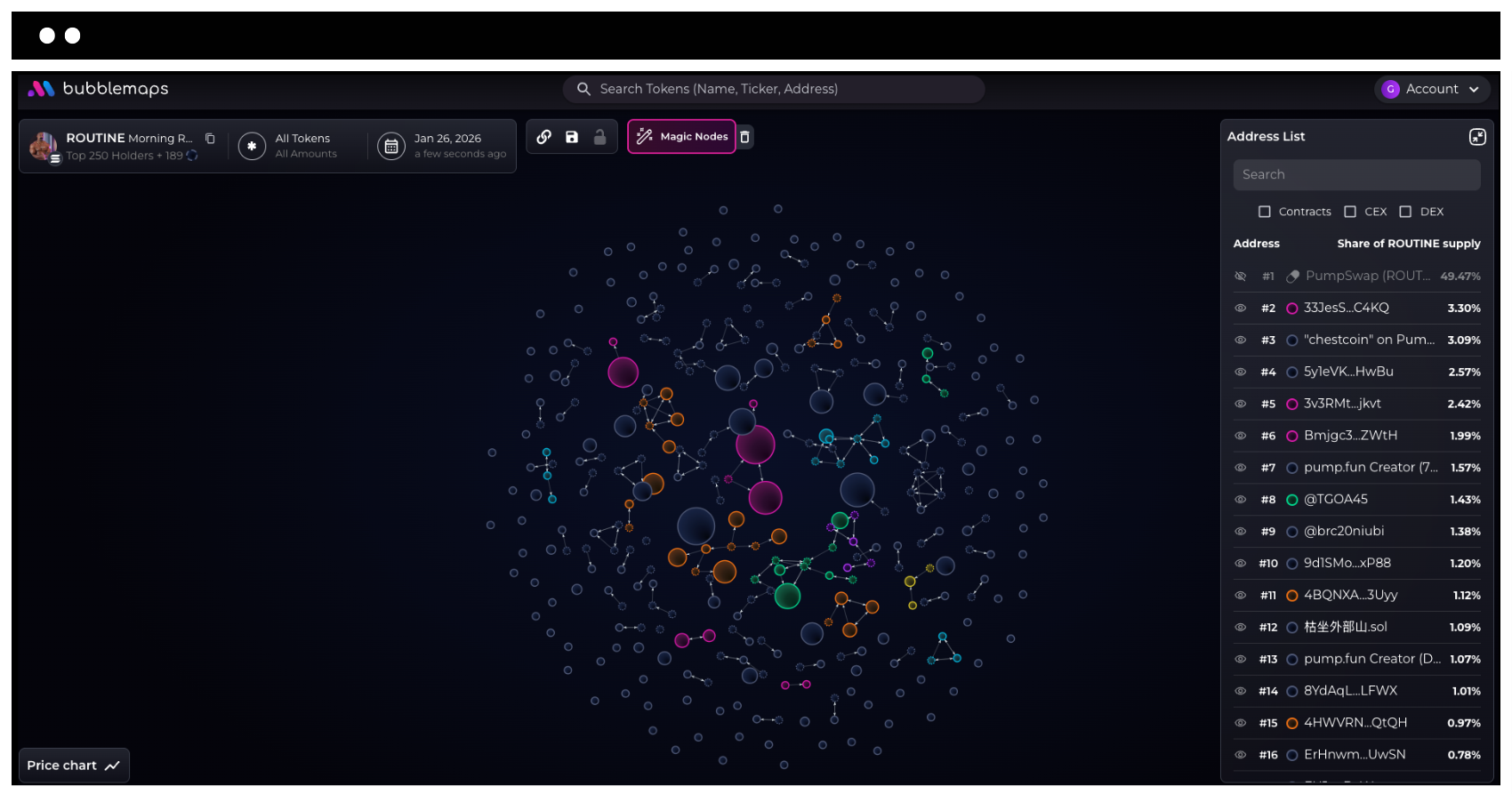
Bubblemaps is an on-chain intelligence tool, and the best at it by far. Their tool is found in many exchanges to trade low and mid-cap tokens.
It also provides support for most popular blockchains, with only a few exceptions. Ethereum, Solana, Base, and Binance are among the chains supported.
The first ones to integrate the bubble chart right next to the trading chart, setting a trend as to what an exchange should deliver.
It is very easy to view the behavior of the "dev" or investment team and their wallets, or check the biggest holders of the token.
You can customize the bubble map however you like, to view the connection between wallets, for instance. A great way to see the true token hold percentage per wallet or wallets.
It works like a true forensics tool would.
"This is, without a doubt, the best tool out there."
InsightX

A solid alternative to Bubblemaps, and I expect this tool to partner with more exchanges to feed their data right on the trading chart, just like its counterparts.
It does offer support for a couple of chains more than its competitor, including Abstract, X Layer, Moonbeam, Fantom, and Arbitrum.
I just dislike that they called their product ‘bubblemaps’ too, which is literally the name of their competitor.
Examples of bundled cryptocurrency tokens? Analyzing multiple assets
Yes, these charts are quite beautiful when bundled, but the reality is quite grim.
Remember, in one pull, these bundlers can crash a token dramatically because they hold so much supply. All in seconds.
$HOOD
Note how the supply is centered and connected across numerous wallets.
Are those side wallets KOLs? If so, let’s hope they do not belong to anyone in our KOL list. The idea is to always filter the noise from people with deceiving intentions.
$LIBRA
Some claim that this token caused irreparable damage to memecoin traders, extracting a substantial amount of capital from the market.
The wildest part again is that both of these tokens were launched by the same wallet address.
Later, the identity of the bundler surfaced. Research done by forensic researcher, Coffeezilla (X: @coffeezilla, a top forensic KOL in crypto, shed light on all this.
The liquidity extracted, along with those affected, built up enough tension to create a manhunt to find the culprits.
You might think that this action might have severe repercussions, which it will, but know that this happens so often that within a few days, the narrative will focus elsewhere.
Steps to avoid buying bundled tokens
The best plan to avoid bundled tokens, those that are clustered by colluding wallets, is to equip yourself with the best tooling.
Yes, Bubblemaps, InsightX will do the trick, but when you are trading at light speed, it’s tedious to jump from tab to tab to check.
Today, we have tools like Axiom, Photon, and Dexscreener, for high-frequency traders, available right by the token chart.
These apps offer a nice package with tons of value, although probably not the best rate for large orders, considering they charge up to 0.95% per order.
Again, these partially free tools will give you access to the best options out there.
Reading the Bundle
One thing that is worth pointing out is that you will often see a massive bubble portraying supply that is actually locked with tools like Streamflow.
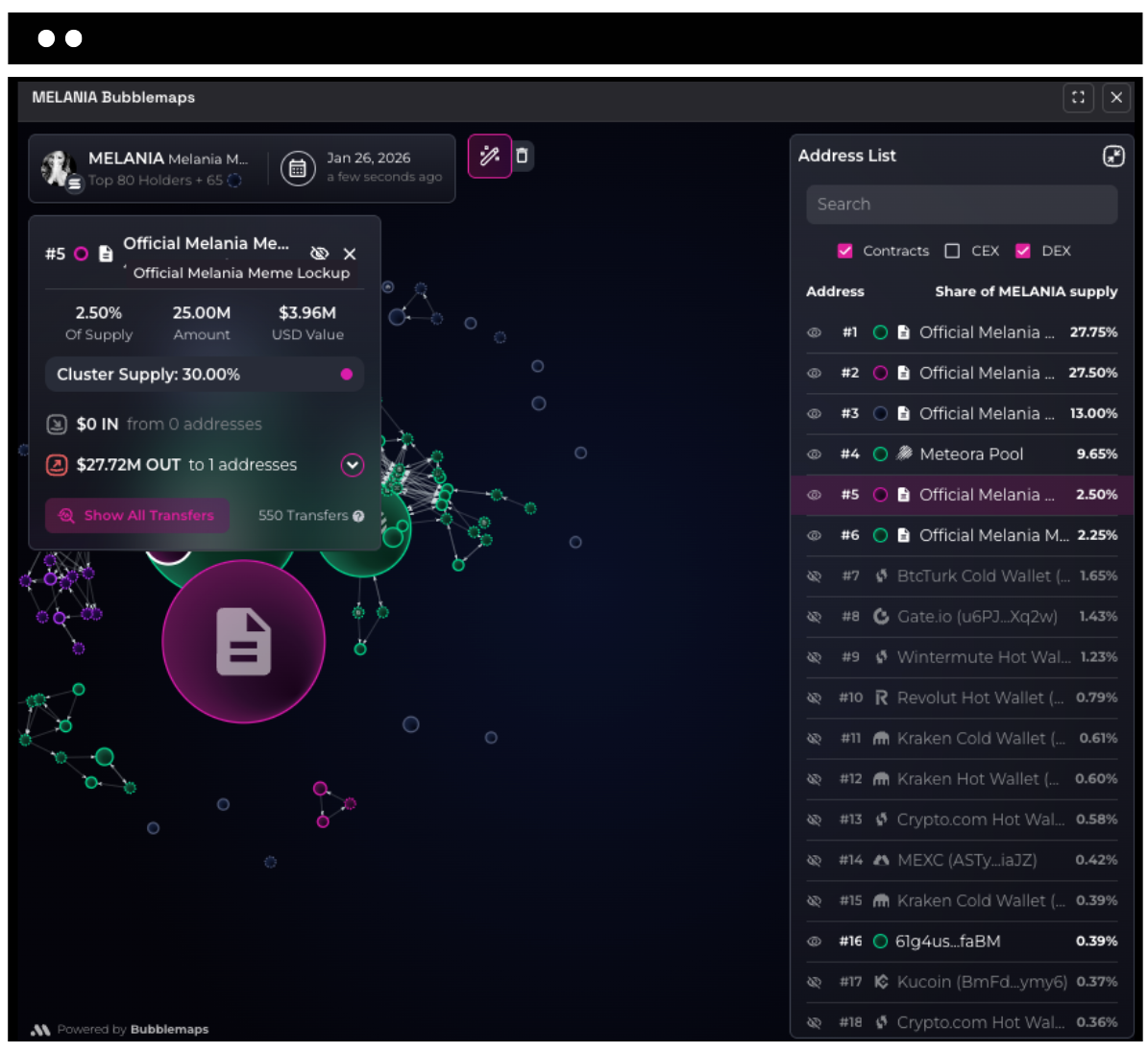
These are funds that will remain untouched, without the ability to be traded, which is actually a huge plus for the project's growth.
Reading Bubblemaps
You will notice a toggle between Contracts, CEXs, and DEXs.

Note the difference:
- Contracts include staking pools, vaults, liquidity locks, etc
- CEXs (centralized exchanges) refer to the biggest exchanges out there. The Coinbase and Krakens of the market. These allow you to trade and on-and-off ramp your crypto into fiat, and vice versa. For them to offer trading, they must hold supply, and that is precisely what you are seeing in Bubblemaps
- DEXs (decentralized exchanges) perform for on-chain transactions only, no exchange with fiat whatsoever. So in this case, you are seeing how much they hold, like any other exchange
When untoggled, you are simply seeing the supply held per individual wallets.

The lines represent connections, or transaction history, showcasing trades and movements back and forth.
DEXs that include Checker Tools like Bubblemaps
Axiom

The most complete high-frequency trading platform out there.
By adding Bubblemaps right to the side of the chart, traders can now make even more informed decisions.
Axiom is by far our top choice for memecoins and quick buys.
Photon
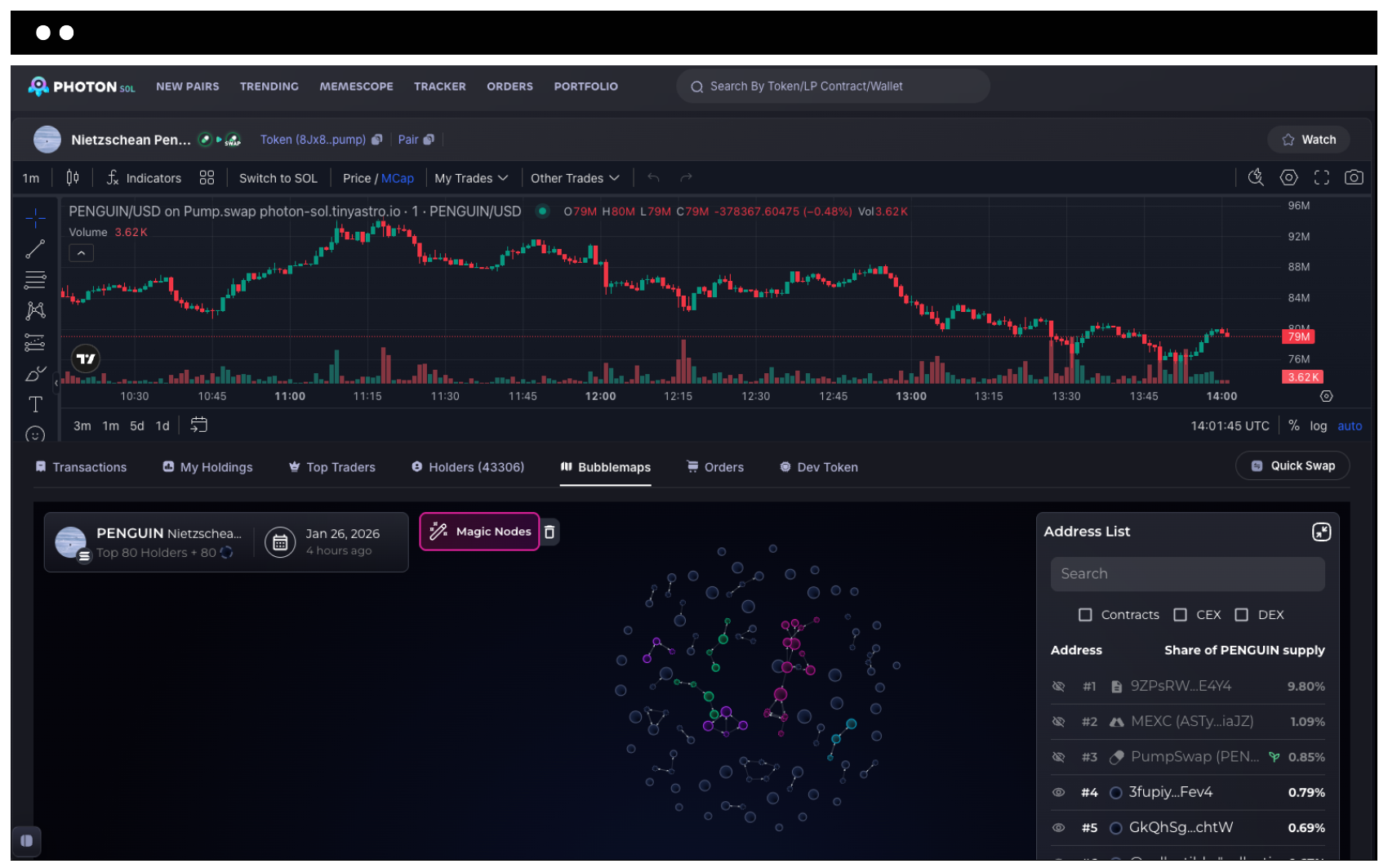
Another great alternative, in fact, they were the ones to really set up a trend with their UI for meme coin trading.
Dexscreener

The best site to check data and charts for all tokens for pretty much every chain out there.
Once you click on any of the tokens, you will find the Bubblemaps available with just a click.
Talking about DEXs, if you ever hear the term "pay for dex", we have a good how-to guide to walk you through it.
Crypto Portfolio Bundles
What Are Investment Bundles?
Geared towards passive traders, these are typically one-click shop buttons to purchase a bundle of assets.
For instance, you could buy Bitcoin, Ethereum, and Solana all at once with ease with an investment bundle. Perfect to trade the largest cryptos.
In one click, your portfolio can be automatically rebalanced to any portfolio structure suggested by the exchange. Not everyone has the time for portfolio management. Therefore, it is a pretty cool feature in my opinion.
These are often pitched by large-scale exchanges like Coinbase or Kraken, for investors who decide to bet on a more passive investment approach.
These also offer the easiest route to cash out to the bank since they are centralized, with off-ramp services to swap from crypto to fiat with ease. They also offer better security benefits in comparison to decentralized exchanges (DEXs).
Orders with multiple assets are no issue nowadays.
Pretty straightforward concept.
Is Bundling Illegal?
No.
It's done across the entire crypto market.
Why would it be?
"It’s just a compilation of orders piled up into one. It could also be seen as a way of diversification for an investor. Remember, you can bundle buy or sell orders."
Another thing we can do in the fast-changing world of decentralized finance.
This one in particular should not be hard to understand and adjust to, visually at least.
Whether they are used maliciously, it really depends on the case.
Spotting Future Bundled Launches
By now you should understand the logic behind a bundle and how to spot them, a piece of information that not all noobs know.
Finding a bundle should always raise suspicion, but luckily, the right tooling can save you from disaster.
Last but not least…
Remember once again to stick to the best tools, maintain a diversified crypto portfolio, stay up to date with market changes, and make informed decisions.
Disclaimer: Some links in this post are affiliate links. When you click through and make a trade or sign up, we may earn a small commission at no extra cost to you. We only recommend platforms and tools we actually use and believe will help you navigate the crypto markets more effectively. This helps us pay the bills, and keep delivering the alpha and market insights you rely on. Thanks for supporting Joined Crypto!






.png)